Author: Techecom Editorial Team · Reviewed by: Senior SEO Strategist, Techecom Last Major Revision: August 2026 · Reviewed against Google’s official documentation: August 2026 Estimated reading time: 38 minutes Maintenance: This guide is reviewed quarterly. Major revisions are issued when Google significantly changes Search, AI Overviews, or ranking systems.
How claims in this guide are sourced: Statements attributed to Google are checked directly against Google’s official Search Central documentation and Search Quality Rater Guidelines as of the revision date above. Statements marked as our own observation come from work we’ve actually done: site audits, content builds, technical fixes, and the outcomes we’ve watched follow from them. Where a recommendation is professional judgment rather than either of those, we say so, and we flag when advice depends on context rather than presenting it as universal. Five callouts mark these distinctions as you read: Google Says (official documentation), Techecom Insight (our own tested experience), Pro Tip (practical, actionable advice), Common Mistake (a pattern we see go wrong, and why), and When This Doesn’t Apply (a genuine exception worth knowing).
On this page:
Foundations
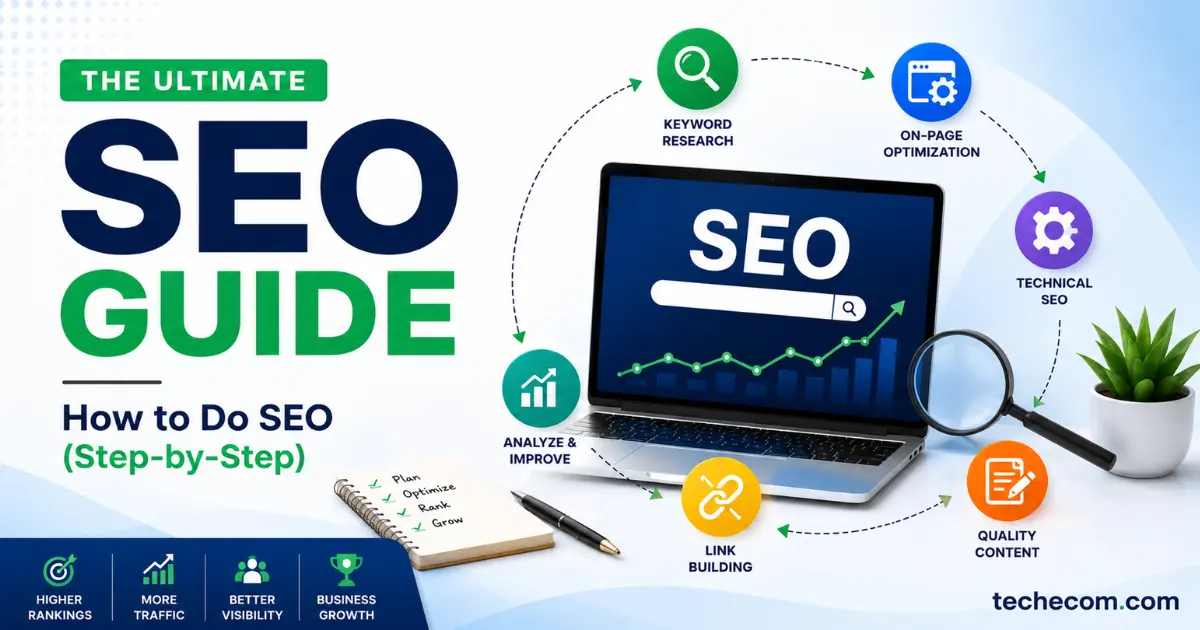
The 11-Step Roadmap
- Understand Your Audience
- Keyword Research
- Content Strategy
- Create Helpful Content
- On-Page SEO
- Technical SEO
- Build Backlinks
- Local SEO
- Ecommerce SEO
- AI SEO & Future Search
- Measure Performance
Wrapping Up
By the End of This Guide You’ll Be Able To
- Explain how search engines crawl, index, and rank content
- Build a keyword and content strategy based on real search intent
- Optimize a page’s on-page elements without over-optimizing
- Fix the technical issues that most commonly hold sites back
- Build backlinks in a way that won’t put your site at risk
- Understand how AI Overviews and generative search change (and don’t change) SEO
- Measure whether any of this is actually working
SEO Guide at a Glance
If you only remember five things from this guide:
- SEO starts with matching search intent, not stuffing keywords.
- Content that reflects real experience and answers the question completely outperforms content that just covers a topic.
- Technical SEO doesn’t rank pages by itself — it removes obstacles that stop your content from being seen.
- Backlinks still matter, but they follow good content; they rarely substitute for it.
- SEO is a compounding, months-to-years strategy, not a campaign with a fixed end date.
Who This Guide Is For — and Who It Isn’t
This guide is written for beginners, bloggers, affiliate marketers, ecommerce store owners, local business owners, SaaS marketers, in-house content teams, agency strategists, developers who need to understand SEO constraints, and experienced professionals who want a structured reference to point clients or junior team members to.
It is not written for anyone looking for guaranteed overnight rankings, automated link schemes, AI-generated content mills, or shortcuts around Google’s Search Essentials. If that’s what you’re after, this isn’t the right guide — and honestly, those approaches tend to cost more in the long run than they save.
How to Use This Guide
You don’t need to read this in order.
- New to SEO? Start at What Is SEO and move through Steps 1–4 before touching anything technical.
- Comfortable with the basics, need execution help? Jump straight to Step 5 through Step 9.
- Technical background, need SEO specifics? Start at Step 6: Technical SEO.
- Already running SEO, want the AI search angle? Go to Step 10: AI SEO.
Before You Begin
A short checklist. If you’re missing any of these, handle them first — the rest of this guide assumes they’re in place.
- Your website is live and publicly accessible
- Google Search Console is installed and verified
- Google Analytics (or an equivalent) is tracking traffic
- You have a basic site structure (not a single unorganized page)
- You have a clear goal for what SEO should accomplish for your business
Introduction
SEO still matters because search remains one of the few channels where people arrive already looking for what you offer. Paid ads stop the moment you stop paying. Social reach depends on a platform’s algorithm and your posting frequency. Search traffic, once you’ve earned it, keeps arriving with comparatively little ongoing spend — which is exactly why it’s worth doing properly instead of chasing shortcuts that put it at risk.
This guide walks through what SEO actually is, how search engines decide what to rank, and the specific, sequential steps to build organic visibility — from understanding your audience through measuring results. It also covers where SEO fits alongside AI Overviews and generative search, since that’s the biggest structural change in how people find information in years.
Be realistic about what to expect. Meaningful organic growth for a new or under-optimized site typically takes months, not weeks, and it compounds rather than spikes. If you’re hoping for guaranteed rankings on a specific timeline, that’s not something any legitimate SEO practitioner (or Google itself) can promise.
What’s Changed for SEO — and What Hasn’t
Search evolves constantly, but not everything changes every year. Here’s what’s meaningfully different heading into 2026, and what’s still the same fundamentals it’s always been.
What’s changed:
- AI Overviews now appear across a much wider range of query types, which has reduced click-through rates on some informational searches — content needs to be structured so it can be extracted, not just read.
- Interaction to Next Paint (INP) replaced First Input Delay (FID) as a Core Web Vital, shifting the responsiveness metric toward real user interaction rather than initial load response.
- Google’s Helpful Content guidance is now fully integrated into the core ranking systems rather than a separate signal, meaning there’s no longer a distinct “helpful content classifier” to specifically target — it’s baked into ranking as a whole.
- Generative Engine Optimization (GEO) has emerged as a distinct practice: optimizing so that AI systems like ChatGPT, Claude, Gemini, and Perplexity can accurately cite and summarize your content, which overlaps with but isn’t identical to traditional SEO.
What hasn’t changed:
- Search intent still determines whether content ranks, regardless of how polished it is.
- Technical crawlability and indexability are still prerequisites, not ranking boosters.
- Backlinks from relevant, authoritative sites still carry weight.
- Thin, generic, unoriginal content still underperforms, whether a human or an AI wrote it.
Google Says: Google’s own Search Central documentation continues to emphasize creating content primarily for people, not search engines, and evaluating content against its “who, how, and why” framework for content creation — who created it, how it was made, and why.
What Is SEO?
SEO (Search Engine Optimization) is the practice of improving a website so it can be found, understood, and ranked by search engines for relevant queries — and, increasingly, so it can be accurately summarized by AI search systems.
Why SEO Still Matters
Search is intent-driven traffic. Someone searching “best project management software for small teams” is actively evaluating options right now. That’s fundamentally different from someone scrolling social media who might notice your ad. SEO captures demand that already exists rather than trying to create it from nothing.
How Modern Search Engines Rank Content
Ranking systems evaluate hundreds of signals, but they cluster into a few practical categories: relevance (does this content match the query and intent), quality and trust (EEAT signals, technical soundness, user experience), and authority (does the web treat this as a credible source, largely through links and mentions). No single factor decides rankings — it’s the combination.
Google Says: Google has repeatedly stated it uses a combination of hundreds of signals, and no individual factor guarantees a particular ranking outcome. Be skeptical of anyone who claims to know an exact ranking “formula.”
SEO vs. Paid Search (Google Ads)
| SEO | Paid Search (PPC) | |
|---|---|---|
| Speed | Slow to build, months+ | Immediate, live same day |
| Cost structure | Time/content investment, lower ongoing cost | Continuous ad spend per click |
| Longevity | Traffic persists after ranking | Stops when budget stops |
| Trust | Often perceived as more credible by users | Clearly marked as an ad |
| Control | Limited — algorithm-dependent | High — bid, targeting, copy all controllable |
When This Doesn’t Apply: If you need traffic immediately, for a product launch next week or a time-sensitive event, SEO alone won’t get you there in time. Most mature businesses run both channels together rather than choosing one.
SEO vs. GEO vs. AEO vs. AI Search Optimization
These terms get used inconsistently, so here’s how we define them:
- SEO — optimizing to rank in traditional search results
- AEO (Answer Engine Optimization) — structuring content so it directly answers questions, useful for featured snippets and voice search
- GEO (Generative Engine Optimization) — optimizing so AI systems can accurately extract, cite, and summarize your content in generated answers
- AI Search Optimization — the umbrella term some use to cover all of the above as search interfaces increasingly blend traditional results with generated answers
In practice, these overlap heavily. Content built for genuine clarity and completeness tends to perform across all four. We treat GEO as a distinct discipline in Step 10.
Who Needs SEO?
Nearly any business with a website benefits from SEO, but the return varies. A local plumber benefits enormously from local SEO with comparatively little content investment. A SaaS company competing in a crowded, high-value keyword space needs sustained content and authority building over years. Understanding which category you’re in shapes how much to invest and how fast to expect results.
Key Takeaways: SEO captures existing demand rather than creating it; ranking depends on the combination of relevance, quality, and authority signals, not one factor; SEO, AEO, and GEO overlap but aren’t identical.
Continue reading: → SEO Glossary · → Search Intent Guide
How SEO Works
Crawling, Indexing, and Ranking
These three stages happen in sequence, and understanding the difference matters because a page can fail at any one of them for entirely different reasons.
Crawling happens when search engine bots (like Googlebot) discover and fetch pages, usually by following links. A page with no links pointing to it, and no submission through a sitemap, may never get crawled at all.
Indexing follows crawling: the page’s content is analyzed and stored in the search engine’s database, which makes it eligible to appear in results. A page can be crawled but never indexed, often because Google judged it low-value, duplicate, or blocked by a directive.
Ranking is the process of ordering indexed pages by relevance and quality for a specific query. Being indexed doesn’t guarantee ranking well, or at all, for any given search.
[Diagram: The Search Visibility Path — Crawl → Index → Rank]
Common Mistake: Assuming a page is “not ranking” when it’s actually not indexed at all. This happens because the symptom looks identical from the outside: the page simply doesn’t show up in search, so it’s tempting to jump straight to content or ranking fixes. Check Google Search Console’s URL Inspection tool first. If the page isn’t indexed, no amount of content or ranking optimization will help until that’s resolved.
Understanding Search Intent
Search intent is what the searcher actually wants, which isn’t always obvious from the keyword alone. Four common categories:
- Informational — “how does compound interest work”
- Navigational — “facebook login”
- Commercial investigation — “best CRM for small business”
- Transactional — “buy standing desk”
The same keyword can carry different intent depending on context, and Google’s results page is usually the clearest signal of what intent it believes dominates a query — check what’s actually ranking before assuming.
Google’s Helpful Content & Quality Systems
Google evaluates content quality holistically rather than through a single isolated signal. Practically, that means content created primarily to rank, rather than to actually help a reader, tends to underperform over time, even if it’s well-optimized on the surface.
AI Overviews and Search Generative Experiences
AI Overviews synthesize information from multiple sources directly into the search results page, sometimes reducing the need for a user to click through. This has real implications: content needs to be structured clearly enough to be extracted and cited accurately, and visibility now sometimes means being the source behind an AI-generated answer rather than the clicked link. We cover this in depth in Step 10.
EEAT and Trust Signals
EEAT (Experience, Expertise, Authoritativeness, Trustworthiness) is Google’s framework, described in its Search Quality Rater Guidelines, for evaluating content and site credibility. It’s not a direct ranking factor you can “add” to a page, but it correlates strongly with the kind of content that performs well: content written by someone who demonstrably knows the subject, on a site that’s credible, that readers can trust.
Techecom Insight: In our experience, the sites that struggle most with EEAT aren’t lacking expertise — they’re lacking evidence of it on the page itself. An experienced author writing anonymously reads the same to an algorithm (and a skeptical reader) as no expertise at all. Byline, credentials, and clear sourcing do real work here.
Key Takeaways: Crawling, indexing, and ranking are separate stages that fail independently; search intent should be verified against actual results, not assumed; EEAT is a quality framework, not a checkbox.
Continue reading: → EEAT Guide · → Google AI Overview Guide
The Four Pillars of SEO
Modern SEO breaks down into four interconnected disciplines. Neglecting any one of them puts a ceiling on what the others can achieve.
- Technical SEO — ensures search engines can access, crawl, and render your site properly
- On-Page SEO — optimizes individual pages’ content and HTML elements for relevance and clarity
- Off-Page SEO — builds external trust and authority signals, primarily through backlinks and brand mentions
- Content SEO — the strategic planning and creation of content that satisfies search intent and demonstrates expertise
Each gets a full, practical treatment in the Steps below.
The Techecom SEO Framework
Rather than treating SEO as a checklist to work through once, we approach it as five ongoing phases:
Understand → Research → Build → Optimize → Measure/Maintain
[Diagram: The Techecom SEO Framework]
- Understand your audience and what they’re actually searching for (Step 1)
- Research keywords and opportunities systematically (Step 2)
- Build content and site structure around real search intent (Steps 3–4)
- Optimize on-page and technical elements so nothing gets in the way (Steps 5–6)
- Measure and maintain — SEO isn’t a one-time project; it requires ongoing tracking, updating, and iteration (Step 11)
Steps 7 through 10 (backlinks, local, ecommerce, AI SEO) layer into this cycle depending on your specific business.
What SEO Can’t Do
Being direct about limitations is part of doing this honestly.
- SEO won’t produce guaranteed rankings. Anyone promising a specific ranking position is either wrong or not being straight with you.
- SEO is slow relative to paid channels. For most competitive terms, meaningful movement takes months. Very competitive terms can take a year or more of sustained effort.
- SEO can’t fix a fundamentally unhelpful product or offering. It can bring the right people to your site — it can’t make them convert if what they find doesn’t match what they need.
- Some industries are simply harder. Highly regulated or highly competitive topics, and “Your Money or Your Life” (YMYL) categories like health, finance, and legal, face a higher quality bar and more established competition.
When This Doesn’t Apply: If you’re in an extremely low-competition niche or a genuinely novel space, some of these limitations soften considerably — you may see faster results simply because there’s less to compete against.
Continue reading: → SEO Timeline Expectations Guide
Step 1 — Understand Your Audience Before Doing SEO
Define Your Ideal Reader
Before researching a single keyword, know who you’re writing for and what problem they’re trying to solve. A guide written for absolute beginners reads very differently than one written for practitioners — trying to serve both equally often serves neither well.
Identify Search Intent
Map your content plans against the four intent types covered earlier. A blog targeting “informational” searches needs a different structure and depth than a product page targeting “transactional” intent.
Find Content Gaps
Look at what your target audience is asking that existing content, yours or competitors’, answers poorly, incompletely, or not at all. Gaps are usually more valuable to fill than competing head-on for terms that are already well-served.
Key Takeaways: Content built for a specific, defined reader outperforms content built to appeal broadly to everyone; content gaps are often better opportunities than head-on competition.
Continue reading: → Search Intent Guide · → Content Gap Analysis Guide
Step 2 — Perform Keyword Research
How to Find SEO Keywords
Start with what you already know your audience asks: customer emails, sales calls, support tickets. Then expand using keyword research tools to find related terms, questions, and variations you hadn’t considered.
Primary vs. Secondary Keywords
A primary keyword is the main term a page is built to rank for. Secondary keywords are related terms and phrases naturally covered within the same content — they shouldn’t require separate pages if intent overlaps closely enough.
Long-Tail & Question-Based Keywords
Long-tail keywords (“technical SEO checklist for WordPress sites”) are longer, more specific phrases. They typically have lower search volume but clearer intent and less competition than broad terms (“SEO”).
Pro Tip: Instead of targeting “SEO,” a term with enormous competition and ambiguous intent, target something like “technical SEO checklist for WordPress.” Lower competition, and you know exactly what the searcher wants.
Semantic Keywords
These are conceptually related terms search engines associate with a topic — not exact keyword matches, but words and entities that naturally appear in comprehensive coverage of a subject. Writing naturally and thoroughly about a topic tends to include these organically; you rarely need to force them in.
Keyword Difficulty & Search Volume
Keyword difficulty estimates how hard a term is to rank for, usually based on the authority of currently ranking pages. Search volume estimates how often a term is searched. Neither should be evaluated alone — a high-volume, high-difficulty term may be a worse target than a lower-volume term that converts better and is realistically winnable.
When This Doesn’t Apply: Keyword difficulty scores matter less if you have a strong existing brand, are targeting a local market with limited competition, or are building topical authority in a niche where traditional difficulty metrics don’t reflect the real competitive picture.
Search Intent Matching
This is where keyword research and search intent connect directly. Beyond just checking what’s ranking, look at the format of the top results: are they blog posts, product pages, comparison tables, videos, or tools? If nine of the top ten results for a term are long-form guides and you’re planning a short product page, that’s a mismatch worth catching before you invest time writing, not after you publish and wonder why it didn’t rank.
Competitor Keyword Research
Studying what competitors rank for surfaces opportunities, but the goal is identifying gaps and better angles — not replicating their content structure or wording.
Best Keyword Research Tools
| Tool | Free or Paid | Best For |
|---|---|---|
| Google Keyword Planner | Free (Google Ads account required) | Search volume estimates, straight from Google’s own data |
| Google Search Console | Free | Finding keywords you already rank for but haven’t targeted deliberately |
| AnswerThePublic | Free tier available | Surfacing question-based and long-tail phrasing |
| Ahrefs | Paid | Keyword difficulty, competitor gap analysis, backlink-informed data |
| Semrush | Paid | Keyword research combined with broader site audit and competitor tracking |
| Moz Keyword Explorer | Paid (limited free searches) | Difficulty scoring with a simpler learning curve for beginners |
Common Mistake: Targeting keywords based purely on search volume, without checking whether the intent matches what you can realistically offer, or whether the difficulty is remotely achievable for your site’s current authority. This tends to happen because volume is the easiest number to see at a glance, while intent and realistic difficulty take more judgment to assess — so it’s the metric that gets prioritized by default. It’s also one of the most common reasons keyword research produces content that never ranks.
Key Takeaways: Long-tail keywords with clear intent often outperform broad, high-competition terms; always verify intent against actual search results before writing; difficulty and volume should be evaluated together, not separately.
Continue reading: → Keyword Research Guide · → Search Intent Guide
Step 3 — Plan Your SEO Content Strategy
Build Topic Clusters
A topic cluster organizes content around a central “pillar” page (broad coverage of a topic) supported by multiple “cluster” pages (deep coverage of specific subtopics), all interlinked. This guide you’re reading is itself a pillar page.
Pillar Pages vs. Cluster Pages
Pillar pages summarize a topic broadly and link out to deeper resources. Cluster pages go deep on one specific subtopic and link back to the pillar. Together, they signal comprehensive topical coverage without forcing any single page to be unreasonably long.
Information Architecture
How your site’s pages are organized and linked affects both user navigation and how search engines understand topical relationships. A flat, disorganized structure makes it harder for both.
Internal Linking Strategy
Internal links distribute authority across your site and help both users and search engines understand which pages matter most and how topics relate.
| Good Internal Linking | Poor Internal Linking |
|---|---|
| Descriptive, varied anchor text | Repeated “click here” links |
| Links placed where contextually relevant | Links dumped in a footer list |
| Points to the most relevant, deepest resource | Points to homepage regardless of context |
| Reasonable number per page | Dozens of links diluting relevance |
Preventing Keyword Cannibalization
Cannibalization happens when multiple pages on your own site compete for the same keyword, splitting authority and confusing search engines about which page to rank. Consolidate overlapping content or clearly differentiate intent between pages.
Building Topical Authority
Topical authority is the accumulated trust a site earns by comprehensively covering a subject area over time, rather than publishing scattered, unrelated content. It’s built through consistent, interlinked, sustained, thorough coverage — not through volume alone.
Key Takeaways: Pillar-and-cluster architecture supports depth without unreasonable page length; internal linking is a strategic tool, not an afterthought; cannibalization is a self-inflicted ranking problem worth auditing for regularly.
Continue reading: → Topical Authority Guide · → Internal Linking Guide
Step 4 — Create Helpful Content That Deserves to Rank
Write for Humans First
Content built primarily to satisfy an algorithm tends to read that way — and increasingly, ranking systems are built specifically to recognize that pattern. Write to actually help the specific reader you defined in Step 1.
Demonstrating Experience, Expertise, Authority, and Trust
Concretely, that means:
- Experience — describing real implementation details, not just theory
- Expertise — using correct terminology and explaining concepts accurately and completely
- Authority — citing credible sources, having a visible author with relevant credentials
- Trust — being transparent about uncertainty, sourcing claims, and keeping content accurate and current
Techecom Insight: Across the audits we’ve done, the content that consistently underperforms relative to its optimization effort is content that’s technically correct but generic — it could have been written about any topic in the niche, by anyone, with no distinguishing insight. That’s the gap EEAT is really measuring.
Matching Search Intent
Revisit Step 2’s intent research when writing. A page that’s beautifully written but structured for the wrong intent (a long narrative blog post, for instance, when searchers want a quick comparison table) will underperform regardless of quality.
Covering Topics Completely
“Complete” doesn’t mean exhaustively long. It means answering the reader’s actual question and the reasonable follow-up questions they’d have, without leaving obvious gaps that send them back to search.
Adding Original Insight
Original insight (a genuine perspective, a documented trade-off, an honest limitation) is what separates content worth citing from content that’s simply competent. It’s also the hardest thing to fake and the easiest thing for both readers and AI systems to recognize as valuable.
Updating Existing Content
Outdated content erodes trust and rankings over time. Regularly reviewing and updating existing pages, not just publishing new ones, is often a higher-return activity than constant new content production.
Optimizing for Featured Snippets & AI Overviews
Clear, direct answers near the top of a section, formatted as concise paragraphs, numbered steps, or tables, are more easily extracted by both featured snippets and AI Overviews. Structure doesn’t guarantee extraction, but it removes a barrier to it.
Key Takeaways: Genuine experience and original insight are what algorithms increasingly reward, because they’re what readers actually value; completeness means answering the real question, not maximizing word count.
Continue reading: → EEAT Guide · → Content Refresh Guide
Step 5 — Master On-Page SEO
Difficulty: Beginner-Intermediate · Estimated time: Ongoing, per page Prerequisite: This step assumes you have content from Step 4 to optimize.
SEO-Friendly URLs
Short, descriptive, readable URLs help both users and search engines understand what a page is about before clicking. /blog/technical-seo-guide communicates more than /blog/post?id=4821.
Writing High-Converting Title Tags
Bad: “SEO Tips” Better: “25 SEO Tips That Actually Work” Best: “25 Proven SEO Tips to Increase Organic Traffic”
The best version is specific, sets accurate expectations, and gives a reason to click without exaggerating.
Meta Descriptions
Meta descriptions don’t directly influence rankings, but a compelling, accurate one can improve click-through rate — which indirectly matters.
Bad: “We offer SEO services. Contact us today to learn more about what we can do for you.” Better: “Technical SEO audits, content strategy, and link building for growing ecommerce and SaaS brands. See our process and recent results.”
The second version tells the searcher specifically what they’ll get, which sets accurate expectations and earns clicks from people who are actually the right fit — rather than clicks that bounce immediately.
Heading Structure (H1–H6)
Headings should reflect a logical outline of the content, not be stuffed with keyword variations. One H1 per page, with H2s and H3s that accurately map to the content’s structure.
Image SEO
Descriptive file names, meaningful alt text (for both accessibility and search context), and compressed file sizes for performance.
Internal & External Links
Link internally to closely related, useful pages. Link externally to credible sources when citing claims or data — this is part of demonstrating trustworthiness, not a ranking loophole to avoid.
Anchor Text Best Practices
Descriptive, varied anchor text (“read our technical SEO checklist”) communicates more to both users and search engines than generic text (“click here”) or exact-match keyword stuffing repeated across every link.
Schema Markup Basics
Schema (structured data) is code added to a page that explicitly tells search engines what specific pieces of content mean — this is a review, this is a price, this is a FAQ answer. It doesn’t guarantee rich results, but it makes eligibility possible.
[Illustration: Common Schema Types and What They Enable]
Google Says: Google’s structured data documentation is explicit that adding structured data doesn’t guarantee a rich result will appear, and that markup must accurately reflect visible page content — marking up content that isn’t actually on the page violates their guidelines.
FAQ Optimization
FAQ sections answer real, specific questions concisely — not manufactured questions designed purely to trigger rich results. Genuine, well-answered FAQs also perform well for AI Overview extraction.
Common Mistake: Applying FAQ schema to content that isn’t structured as clear questions and answers on the page. This usually happens when schema is added purely to chase a rich result rather than to describe content that’s genuinely there — which is both a guideline violation and, separately, just poor user experience.
Key Takeaways: On-page elements should communicate clearly to both readers and search engines, not attempt to game either; schema enables eligibility for rich results, it doesn’t guarantee them.
Continue reading: → Title Tag Guide · → Schema Markup Guide
Step 6 — Improve Technical SEO
Difficulty: Intermediate-Advanced · Estimated time: Varies significantly by site size
The Fundamentals
- Crawling & XML Sitemaps — a sitemap helps search engines discover your pages, especially on large or poorly linked sites; it’s a discovery aid, not a ranking factor.
- Robots.txt — controls which parts of a site crawlers can access; misconfiguring it can accidentally block your entire site from being crawled.
- Canonical Tags — tell search engines which version of duplicate or similar content is the “master” version, consolidating ranking signals.
- Crawl Budget — the number of pages a search engine will crawl on your site in a given period; mainly a concern for very large sites, not small ones.
- Pagination — how multi-page content series (like paginated blog archives) are structured so search engines understand the relationship between pages.
- Duplicate Content — identical or near-identical content across multiple URLs, which can dilute ranking signals and confuse which version should rank.
- HTTPS & Mobile-Friendliness — baseline requirements at this point rather than differentiators; sites lacking either are at a real disadvantage.
When This Doesn’t Apply: Crawl budget is rarely a meaningful constraint for small to mid-sized sites (roughly under a few thousand pages). If you’re troubleshooting a small site’s rankings, crawl budget is almost never the actual cause.
Core Web Vitals
Core Web Vitals measure real-world user experience around loading and interactivity. Three current metrics:
- LCP (Largest Contentful Paint) — how long it takes for the main content to become visible
- INP (Interaction to Next Paint) — how responsive the page is to user interactions, replacing FID
- CLS (Cumulative Layout Shift) — how much visual content unexpectedly shifts during loading
Google Says: Google’s published thresholds classify a “good” experience as LCP under 2.5 seconds, INP under 200 milliseconds, and CLS under 0.1, measured at the 75th percentile of page loads across mobile and desktop. Scores above these ranges fall into “needs improvement” or “poor,” which can affect both user experience and how your pages are evaluated.
[Illustration: Core Web Vitals Thresholds — Good, Needs Improvement, Poor]
Techecom Insight: In practice, most Core Web Vitals problems we see trace back to unoptimized images, render-blocking scripts, or third-party ad and tracking scripts — not fundamental architecture issues. Fixing the obvious offenders often resolves most of the problem before you need deeper technical intervention.
JavaScript SEO
Search engines can render JavaScript, but rendering happens as a separate, resource-intensive step after initial crawling — which means JavaScript-dependent content can be delayed in indexing, or in some cases missed if rendering fails. Server-side rendering or pre-rendering reduces this risk for content-critical pages.
Structured Data
Beyond the basics covered in Step 5, structured data at a technical level involves validating markup, avoiding conflicting schema types, and ensuring it’s implemented consistently across templates rather than page by page.
Key Takeaways: Technical SEO removes obstacles rather than actively boosting rankings; Core Web Vitals problems are usually diagnosable and fixable without a full rebuild; crawl budget concerns scale with site size.
Continue reading: → Core Web Vitals Guide · → JavaScript SEO Guide · → XML Sitemap Guide
Step 7 — Build High-Quality Backlinks
Difficulty: Advanced · Estimated time: Ongoing Prerequisite: Backlink outreach works best once you have content actually worth linking to.
Should You Build Backlinks Yet?
If your site has thin or underdeveloped content: hold off. Outreach for weak content typically fails, and it can waste relationships you’ll want later.
If your site has solid, complete content: you’re ready to start.
Why Backlinks Matter
Links from other sites function as a trust signal — an indication that other credible sources consider your content worth referencing. Not all links carry equal weight.
What Makes a Quality Link?
Relevance (is the linking site topically related), authority (does the linking site have its own established credibility), and context (is the link placed naturally within relevant content, not a sitewide footer link) all matter more than raw link count.
Natural Link Building Approaches
- Digital PR — earning coverage and links through newsworthy research, data, or expert commentary
- Guest posting — contributing content that adds real value to relevant publications, done sparingly and for relationship/exposure value, not manufactured volume
- Resource page outreach — identifying curated resource pages relevant to your content and suggesting inclusion where it’s truly warranted
- Broken link building — finding broken links on relevant sites and suggesting your content as a replacement
- Linkable assets — original research, tools, or data that other sites want to reference on their own merit
Links to Avoid
Paid links designed purely to manipulate rankings, link farms, and low-quality directory submissions violate Google’s guidelines and carry real risk — including manual penalties that can be difficult and time-consuming to recover from.
Google Says: Google’s link spam documentation explicitly states that buying or selling links that pass ranking credit, or participating in link exchange schemes, violates its guidelines, and that Google’s systems are designed to identify and discount these links — sometimes alongside manual action against the site.
Common Mistake: Chasing link volume instead of link relevance. A handful of links from truly authoritative, topically related sites will typically outperform dozens of low-quality, unrelated ones — and carries none of the risk.
Key Takeaways: Link building should follow content quality, not substitute for it; relevance and authority matter more than volume; manipulative link schemes carry real, sometimes severe, risk.
Continue reading: → Link Building Guide · → Digital PR Guide
Step 8 — Local SEO (If You Serve Local Customers)
Google Business Profile
A complete, accurate, actively managed Google Business Profile is often the single highest-impact local SEO action available — it directly affects visibility in local map results and local pack listings.
Local Citations & NAP Consistency
Citations are mentions of your business name, address, and phone number (NAP) across directories and other sites. Consistency across all of them matters more than sheer citation volume.
Local Reviews
Review quantity, recency, and your responses to them factor into local ranking and directly influence customer trust and conversion.
Local Landing Pages
For businesses serving multiple locations, dedicated pages for each distinct location (not templated pages that just swap a city name) perform meaningfully better and avoid thin-content issues. A templated page for “Plumbing Services in Austin” and “Plumbing Services in Dallas” that differs only in the city name reads as thin to both users and search engines. A page that references the actual service area, local permitting quirks, or genuinely location-specific details holds up far better.
Local Schema & Local Keyword Research
LocalBusiness schema helps search engines understand location-specific details explicitly. Local keyword research should account for “near me” style queries and location-specific phrasing patterns.
Key Takeaways: Google Business Profile completeness is disproportionately impactful for local visibility; NAP consistency and genuine, non-templated local pages both matter for trust and rankings.
Continue reading: → Local SEO Guide · → Google Business Profile Guide
Step 9 — Ecommerce SEO
Prerequisite: Assumes the on-page and technical fundamentals from Steps 5–6 are already in place.
Product Page Optimization
Unique product descriptions (not manufacturer copy duplicated across hundreds of competing sites), clear specifications, and genuine customer reviews all support both rankings and conversion.
For example, a retailer selling the same ceramic mug as fifty other stores gains little from reusing the manufacturer’s stock description. Adding specifics that only this store can speak to (how it holds heat compared to alternatives it also sells, sizing relative to other mugs in the same collection, care instructions based on actual customer questions) creates content that’s both more useful and genuinely differentiated from competing listings of the identical product.
Category Pages
Category pages need real, unique introductory content and clear internal linking — treating them as pure product-listing pages with no textual context is a common missed opportunity.
Product & Review Schema
Product schema can enable rich results showing price, availability, and rating directly in search results. Review schema must reflect genuine, verifiable reviews — fabricated or incentivized reviews marked up as organic ones violate guidelines.
Faceted Navigation & Duplicate Product Content
Faceted navigation (filtering by size, color, price) can generate enormous numbers of near-duplicate URLs if not handled carefully with canonical tags or parameter handling, which can waste crawl budget on larger catalogs.
Key Takeaways: Unique content on product and category pages meaningfully outperforms duplicated manufacturer copy; faceted navigation needs deliberate technical handling to avoid duplicate content sprawl.
Continue reading: → Ecommerce SEO Guide · → Product Schema Guide
Step 10 — AI SEO & Future Search Optimization
Optimizing for Google AI Overviews
AI Overviews synthesize answers from multiple sources. Content structured with clear, direct answers near the top of relevant sections, strong factual accuracy, and credible sourcing is more likely to be drawn on.
GEO (Generative Engine Optimization)
GEO focuses specifically on being accurately represented and cited by generative AI systems — ChatGPT, Claude, Gemini, Perplexity. This overlaps with traditional SEO but places extra weight on clear factual statements, proper attribution-friendly formatting, and content that’s unambiguous when extracted out of its original page context.
Entity SEO & Knowledge Graph Optimization
Entity SEO focuses on helping search engines understand your brand, products, and key concepts as distinct, connected “entities,” rather than just strings of text, through consistent naming, structured data, and authoritative mentions across the web.
Brand Authority Signals & Citation Optimization
Being mentioned, cited, and linked to by credible sources across the web, not just on your own site, increasingly reinforces both traditional authority and AI systems’ confidence in citing you accurately.
Conversational, Voice, and Multimodal Search
Conversational and voice search favor natural-language, direct-answer content. Multimodal search (combining text, image, and video understanding) rewards well-structured, clearly labeled visual and video content alongside text.
Techecom Insight: We’ve found that content optimized honestly for human clarity (direct answers, accurate claims, clear structure) tends to perform well across AI Overviews, voice search, and generative engines without needing a fundamentally separate strategy. The overlap with good traditional SEO is larger than most GEO-specific advice suggests.
Key Takeaways: GEO and traditional SEO overlap substantially; clarity and factual accuracy matter more in AI-mediated search, not less; entity consistency across the web reinforces both SEO and AI citation accuracy.
Continue reading: → Google AI Overview Guide · → GEO Guide · → Entity SEO Guide
Step 11 — Measure SEO Performance
Google Search Console & Google Analytics 4
Search Console shows how Google sees and ranks your site: impressions, clicks, average position, indexing status. GA4 shows what happens after visitors arrive: behavior, conversions, engagement.
Track Rankings, Organic Traffic, and Conversions
Rankings alone are a vanity metric if they’re not translating into traffic and, ultimately, conversions. Track all three together, not rankings in isolation.
Monitor Click-Through Rate & Core Web Vitals
CTR trends by query reveal whether your titles and descriptions are compelling relative to your ranking position. Core Web Vitals should be monitored on an ongoing basis, not checked once and forgotten.
Pro Tip: Don’t just watch top-line organic traffic in GA4 — review query-level performance in Search Console’s Performance report regularly. A flat traffic trend can hide individual queries that are climbing and others that are declining, and that detail is usually where the actionable insight actually is.
Measure Topical Authority Growth
Harder to quantify directly, but trends like increasing rankings across a whole topic cluster, growing branded search volume, and rising organic visibility across related terms are reasonable proxies.
Key Takeaways: Rankings, traffic, and conversions should be measured together, not treated as interchangeable success metrics; measurement should be ongoing, not a one-time audit.
Continue reading: → Google Search Console Guide · → SEO Audit Guide
DIY SEO vs. Hiring an Agency or Freelancer
DIY makes sense when: you have the time to learn and apply this consistently, your business is small enough that incremental gains matter more than speed, or your niche has relatively low competition.
Hiring makes sense when: you’re in a competitive space where mistakes are costly, you don’t have the internal time to execute consistently, or you need technical SEO expertise beyond content (site migrations, large-scale technical audits).
Realistic cost expectations vary enormously by scope — from a few hundred dollars a month for a freelancer handling focused content work, to several thousand a month for a full-service agency handling technical, content, and link building simultaneously. Be wary of any provider promising specific rankings or guaranteed timelines; as covered earlier, that’s not something legitimate SEO can guarantee.
Red flags when hiring: guaranteed rankings, refusal to explain their link-building methods, reporting that only shows rankings without traffic or conversion data, and pricing that seems dramatically below market rate for the scope promised.
5 SEO Improvements You Can Make Today
- Fix any broken internal links or 404 pages
- Rewrite your three weakest title tags to be specific and accurate
- Add descriptive alt text to images that are currently missing it
- Compress oversized images slowing down page load
- Submit or resubmit your XML sitemap in Google Search Console
Common SEO Mistakes to Avoid
- Keyword stuffing — unnatural repetition that reads poorly and can trigger quality issues
- Thin content — pages that don’t sufficiently answer the query they’re targeting
- Duplicate content — identical or near-identical content across multiple URLs without canonicalization
- Ignoring search intent — optimizing a page for a keyword whose actual search results don’t match the page’s format
- Buying spammy backlinks — trading short-term link volume for real penalty risk
- Poor internal linking — leaving valuable pages orphaned or under-linked
- Slow website speed — losing both users and Core Web Vitals standing
- Publishing without updating — treating content as finished rather than maintained
Tactics That Used to Work (and Don’t Anymore)
Keyword density targets, mass low-quality directory submissions, article spinning, exact-match anchor text abuse, private blog networks (PBNs), and doorway pages were once viable shortcuts. All of them now carry real risk of manual action or algorithmic devaluation, and none reliably work today.
Essential SEO Tools
| Category | Free Options | Paid Options |
|---|---|---|
| Technical audits & indexing | Google Search Console, Google’s Rich Results Test | Screaming Frog SEO Spider, Sitebulb |
| Site speed & Core Web Vitals | Google PageSpeed Insights, Chrome DevTools | GTmetrix Pro, DebugBear |
| Keyword research | Google Keyword Planner, AnswerThePublic (limited) | Ahrefs, Semrush, Moz Keyword Explorer |
| Backlink analysis | Google Search Console (your own links only) | Ahrefs, Semrush, Majestic |
| Rank tracking | Google Search Console (your own rankings only) | Ahrefs, Semrush, AccuRanker |
| Analytics | Google Analytics 4 | Most paid suites include some traffic reporting |
Free tools worth starting with: Google Search Console, Google Analytics, Google’s PageSpeed Insights, and Google’s Rich Results Test cover a large share of what most sites need before paid tools become necessary.
SEO Checklist (Quick Summary)
Technical: sitemap submitted, robots.txt correct, HTTPS enabled, mobile-friendly, Core Web Vitals in acceptable range, no major crawl errors
On-Page: unique title tags and meta descriptions, logical heading structure, descriptive URLs, alt text on images, relevant internal links
Content: matches search intent, demonstrates real expertise, answers the query completely, reviewed/updated regularly
Off-Page: backlink profile from relevant, authoritative sites, no manipulative link schemes, active digital PR or outreach where appropriate
Local: Google Business Profile complete and active, NAP consistent across citations, genuine local landing pages if multi-location
AI SEO: clear, extractable answers near the top of key sections, accurate structured data, consistent entity naming across the web
Frequently Asked Questions
What is SEO? SEO is the practice of improving a website so search engines can find, understand, and rank it for relevant searches, and increasingly, so AI search systems can accurately reference it.
How long does SEO take? Meaningful movement typically takes several months for a reasonably competitive term, with continued growth over a year or more. Very low-competition niches can see faster results.
Can beginners learn SEO? Yes. The core concepts are accessible without a technical background, though technical SEO specifically benefits from at least basic familiarity with how websites work.
Is SEO free? The tactics themselves don’t require payment, but they require significant time investment, and most businesses eventually use at least some paid tools or outside help to scale effectively.
Is SEO worth it in 2026? For most businesses with a website, yes — search remains a major source of intent-driven traffic, and AI search systems still rely heavily on well-optimized, credible web content as their source material.
What are the different types of SEO? Commonly categorized as technical, on-page, off-page, local, and increasingly, AI/generative search optimization — each covered in this guide.
How often should I update content? There’s no universal schedule — high-value, time-sensitive, or underperforming pages benefit from more frequent review, while stable evergreen content might only need an annual check.
How do AI Overviews affect SEO? They can reduce click-through on some queries where the answer is fully satisfied in the overview itself, but they also create a new visibility channel — being the cited source within an AI-generated answer.
Does SEO still work? Yes. What’s changed is the range of surfaces where SEO effort pays off — traditional results, featured snippets, and AI-generated answers all draw from the same underlying signals of relevance, quality, and trust.
What is the future of SEO? Increasing overlap between traditional search optimization and generative engine optimization, with more emphasis on structured, extractable, verifiably accurate content across both.
How much does SEO cost? Ranges widely — from no direct cost if done entirely in-house (beyond time), to a few hundred dollars monthly for freelance help, to several thousand monthly for full-service agency work on competitive terms.
Should I hire an SEO agency or do it myself? Depends on your available time, the competitiveness of your space, and whether you need specialized technical expertise. See the DIY vs. Hiring section above for a fuller breakdown.
Final Thoughts
SEO in 2026 still rests on the same foundation it always has: understand what people are really searching for, build content and a site that serves that need, and remove the technical obstacles that stop search engines from recognizing that value. What’s changed is the surface area — AI Overviews, generative engines, and conversational search all now draw on the same underlying signals of relevance, quality, and trust that traditional SEO has always rewarded.
Treat this as a starting reference, not a one-time task list. Revisit the sections relevant to where you are now, apply them, measure the results, and adjust. That iterative cycle, not any single tactic, is what sustainable organic growth actually looks like.
Next Steps to Continue Learning
Explore the dedicated guides linked throughout this article for deeper coverage of any specific topic — starting with whichever Step above is most relevant to where your site needs the most work right now.