How this guide was built: Every statistic in this article is pulled directly from a named primary source (Stanford HAI, the World Economic Forum, the FDA, or the IEA) and linked so you can verify it yourself. Every AI capability described was checked against how the underlying technology actually works, not vendor marketing claims. Where something is our professional interpretation rather than a documented fact, we say so explicitly. See our full methodology for details.
Artificial intelligence stopped being a “future technology” a while ago. It’s already inside your phone’s camera, your bank’s fraud alerts, your doctor’s diagnostic tools, and the search results you’re reading right now. Most people interact with AI dozens of times a day without noticing it.
Quick answer: AI is changing the world by automating repetitive work, helping people make faster and more informed decisions, personalizing everyday digital experiences, and enabling breakthroughs in medicine, science, and engineering that would take humans far longer to reach alone. According to Stanford’s 2025 AI Index Report, enterprise AI adoption reached roughly 78% of organizations — up sharply from a few years earlier — which is the clearest single signal that this shift has already moved from experimental to mainstream.
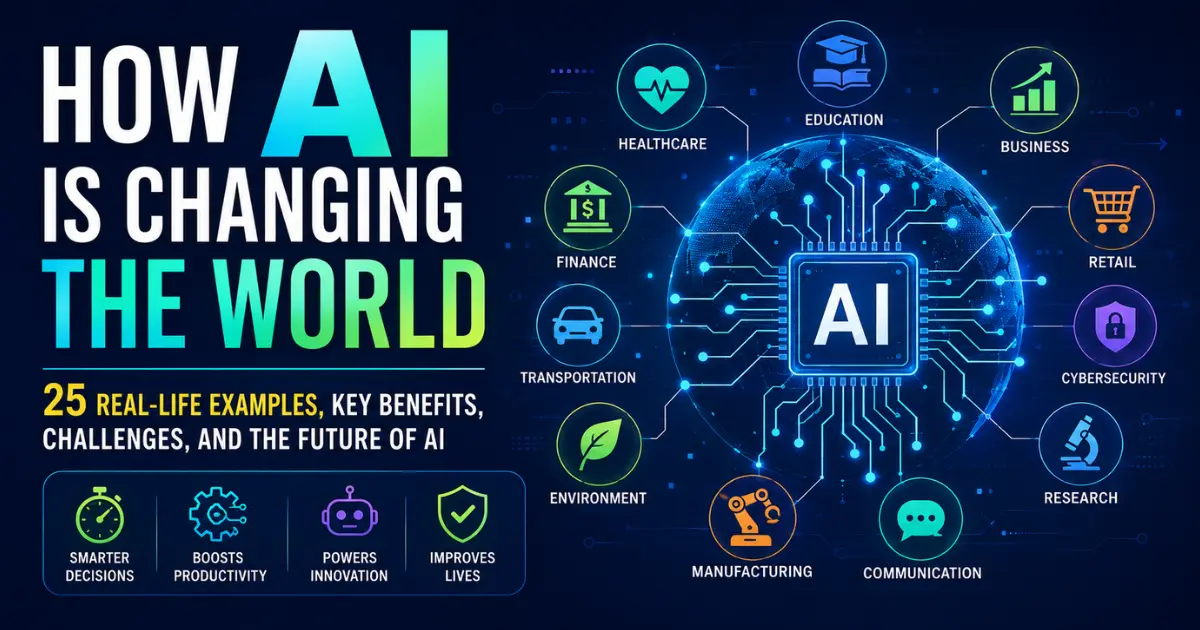
This guide covers 25 concrete, real-world examples of that shift across major industries, what’s actually true versus hyped, and how to prepare for what’s coming next — with sourcing you can verify yourself.
Table of Contents
- What Is Artificial Intelligence?
- A Short History: How AI Got Here
- AI Terms You’ll Keep Seeing
- Why AI Matters More Than Ever
- 25 Real-Life Examples of How AI Is Changing the World
- Benefits of AI
- Challenges and Risks of AI
- Common Misconceptions About AI
- What AI Can (and Can’t) Do Right Now
- Industries Being Transformed Fastest
- The Future of AI
- How to Prepare for an AI-Powered Future
- Frequently Asked Questions
- Key Takeaways
- Our Methodology & Sources
What Is Artificial Intelligence?
Artificial intelligence (AI) is technology that allows computers to perform tasks that normally require human intelligence — recognizing patterns, understanding language, making predictions, and adapting based on data.
AI isn’t one single thing. It’s an umbrella term covering several related but distinct technologies:
- Machine Learning (ML): A subset of AI where systems learn patterns from data instead of following hardcoded rules. Example: a spam filter that gets better at catching junk email the more examples it sees.
- Deep Learning: A type of machine learning that uses layered neural networks (loosely modeled on how neurons connect in the brain) to handle more complex patterns, like recognizing faces in photos or transcribing speech.
- Natural Language Processing (NLP): The branch of AI focused on understanding and generating human language. This powers chatbots, translation tools, and voice assistants.
- Computer Vision: AI that interprets visual information — photos, video, live camera feeds. This is what lets a self-checkout kiosk recognize a product or a car detect a pedestrian.
- Generative AI: AI that creates new content — text, images, audio, video, or code — based on patterns learned from training data. Tools like ChatGPT, Claude, and Midjourney fall into this category. Generative AI tools are typically built on large language models (LLMs) or foundation models — very large neural networks trained on broad datasets that can then be adapted to many different tasks.
Show Image How AI, machine learning, deep learning, and generative AI relate to each other. See the related concepts for definitions of the terms used here.
Simple example: When Netflix recommends a show, that’s machine learning. When your phone transcribes a voicemail, that’s NLP. When a photo app automatically tags your dog in pictures, that’s computer vision. When an app writes a first draft of an email for you, that’s generative AI.
These distinctions matter because “AI” gets used loosely in the media. Not every AI system is generative, and not every generative tool is trustworthy for every task — the right AI tool depends on the job. For a deeper breakdown, see our complete guide to how AI works.
A Short History: How AI Got Here
Understanding where AI is headed is easier once you see how fast it accelerated. The field itself isn’t new — but its move into daily life is recent and rapid.
Show Image
- 1956 — The term “artificial intelligence” is coined at a Dartmouth research conference, marking the formal start of AI as an academic field.
- 1997 — IBM’s Deep Blue defeats world chess champion Garry Kasparov, one of the first widely covered “AI beats human” moments.
- 2012 — A deep learning model dramatically outperforms competitors in the ImageNet computer vision competition, kicking off the modern deep learning era.
- 2020 — Large language models scale up significantly, laying the technical groundwork for today’s chatbots and writing assistants.
- 2022–2026 — ChatGPT’s public launch in late 2022 triggers mass consumer adoption of generative AI. By 2025, Stanford HAI’s AI Index reported enterprise adoption had reached about 78% of organizations, alongside a sharp rise in corporate AI investment and rapidly falling costs to run AI models.
The takeaway: AI research is 70 years old, but AI as an everyday consumer and business tool is only a few years old. That gap between how long the technology has existed and how quickly it’s been adopted is a big part of why the impact feels so sudden.
AI Terms You’ll Keep Seeing
A quick-reference glossary for terms used throughout this guide and across most AI coverage today:
| Term | What It Means |
|---|---|
| LLM (Large Language Model) | An AI model trained on massive amounts of text to understand and generate human language (e.g., the models behind ChatGPT and Claude). |
| Foundation model | A large, general-purpose AI model trained on broad data that can be adapted for many specific tasks, rather than built for just one. |
| AI agent | An AI system that can take multi-step actions toward a goal (like researching, drafting, and sending an email) with limited human input at each step, rather than just answering a single question. |
| Hallucination | When an AI system generates information that sounds plausible but is factually incorrect — a known limitation of generative AI that requires human fact-checking. |
| Training vs. inference | “Training” is the process of teaching a model using data; “inference” is the model actually being used to generate an answer or prediction afterward. |
| Human-in-the-loop | A system design where a human reviews or approves AI output before it’s finalized — standard practice for high-stakes use cases like healthcare or legal work. |
| Algorithmic bias | Systematic errors in AI output that unfairly disadvantage certain groups, usually inherited from patterns in the training data. |
Why AI Matters More Than Ever
AI’s growing importance comes down to a handful of practical, measurable shifts:
- Productivity: AI handles repetitive, time-consuming tasks (data entry, scheduling, first-draft writing) in seconds, freeing people for higher-value work.
- Automation: Processes that once required manual monitoring — fraud detection, quality control, inventory forecasting — now run continuously in the background.
- Better decision-making: AI can process far more data than a human team can review manually, surfacing patterns that inform faster, more accurate decisions.
- Personalization: From product recommendations to learning platforms, AI tailors experiences to individual behavior instead of a one-size-fits-all approach.
- Economic impact: Corporate investment in AI reached $252.3 billion in 2024, a 44.5% increase over the previous year, according to Stanford HAI’s AI Index Report. The World Economic Forum’s Future of Jobs Report 2025 similarly projects that AI and related technologies will help create 170 million new roles globally by 2030, while displacing 92 million existing ones — a net increase of roughly 78 million jobs, based on a survey of over 1,000 employers across 55 economies.
That last stat is worth sitting with: AI’s economic effect isn’t simply “fewer jobs.” It’s a large-scale reshuffling of which jobs exist, and that transition creates real winners and real disruption at the same time — a nuance worth remembering every time you see a headline claiming AI will “destroy” or “save” the job market outright.
25 Real-Life Examples of How AI Is Changing the World
Each example below covers what the AI actually does, real applications, the benefits, the honest challenges, and where it’s headed. Related deep dives are linked throughout — see AI in Healthcare, AI in Marketing, and AI in Cybersecurity for full breakdowns of the biggest categories.
1. Healthcare
AI-assisted screening tools now help radiologists flag possible tumors in mammograms and CT scans faster than manual review alone. Hospitals use predictive models to identify patients at risk of sepsis or readmission, and pharmaceutical companies use AI to narrow down promising drug candidates before expensive lab testing begins.
This isn’t a small or emerging category anymore. The FDA has authorized more than 1,000 AI-enabled medical devices through its established premarket pathways, and independent tracking of the FDA’s public device list shows the total climbing past 1,400 devices by the end of 2025, the large majority concentrated in radiology.
Benefits: Faster diagnoses, reduced administrative burden on clinicians, earlier detection of disease.
Challenges: AI tools can inherit bias from the data they’re trained on, which can affect accuracy across different patient populations. Every device on the FDA’s list still went through a formal safety and efficacy review — but that review confirms the tool works as described, not that it should be trusted without physician oversight. It’s a support tool, not a replacement for medical judgment.
Worth knowing: In practice, the biggest bottleneck in healthcare AI usually isn’t the model’s accuracy — it’s integration with legacy hospital record systems, which is why adoption has been slower here than in, say, retail.
Illustrative example: Picture a mid-sized community hospital radiology department. A radiologist reviews an AI-flagged chest CT scan where the software highlighted a small nodule easy to miss on a busy shift. The AI didn’t make the diagnosis — the radiologist did, after confirming the flag — but it cut the time to catch a borderline case from minutes of manual scanning to seconds of triage. This is a representative scenario based on how FDA-authorized radiology AI tools are designed to be used, not a specific real case.
Future potential: More personalized treatment plans based on a patient’s genetic and health data, and AI-assisted early detection for conditions that are currently hard to catch early. Read more in AI in Healthcare.
2. Education
Platforms like Khan Academy and Duolingo use AI to adjust lesson difficulty based on a student’s performance in real time. Teachers use AI to draft lesson plans and quizzes faster, and students increasingly use AI tutors to get explanations outside class hours.
Benefits: Personalized pacing, more accessible tutoring for students who can’t afford one-on-one help, reduced grading workload for teachers.
Challenges: Overreliance can weaken critical thinking if students use AI to bypass learning instead of supporting it. Schools are still developing clear policies on acceptable use, and accuracy isn’t guaranteed — AI tutors can be confidently wrong, which is exactly why the “human-in-the-loop” concept matters here too.
Future potential: Fully adaptive curricula that adjust in real time to each student’s strengths and gaps, plus AI-assisted accessibility tools for students with learning differences.
3. Search Engines
Google uses AI models to understand the meaning behind a search query, not just the exact words typed. AI Overviews now summarize information from multiple sources directly on the results page for many queries — a shift that’s actively reshaping how content needs to be structured to be found and cited.
Benefits: More relevant results, faster answers to simple questions, better handling of natural, conversational search queries.
Challenges: AI-generated summaries can occasionally misinterpret source content, and websites are seeing shifts in click-through behavior as more answers appear directly on the results page.
Future potential: Search is trending toward “answer engines” that blend traditional links with AI-generated synthesis, plus growing use of AI assistants (ChatGPT, Perplexity, Gemini) as an alternative entry point to information. This is exactly why Techecom teaches Generative Engine Optimization alongside traditional SEO now.
4. Business Operations
Retailers forecast inventory needs by season using AI. Companies run AI-powered analytics dashboards to spot sales trends instantly instead of waiting on manual reports, and AI tools now automate repetitive back-office tasks like invoice processing.
Benefits: Faster reporting, reduced human error in repetitive tasks, better resource allocation.
Challenges: Implementation costs and the need for clean, reliable data can be real barriers, especially for smaller businesses. AI recommendations still need human review, particularly for high-stakes decisions.
Future potential: More businesses adopting AI agents that can complete multi-step tasks — research, drafting, scheduling — with minimal supervision.
5. Marketing
E-commerce brands personalize product recommendations based on browsing history. Marketers use AI tools to generate first-draft ad copy, then refine it, and predictive analytics help identify which customers are likely to churn before they do.
Benefits: More relevant advertising, faster content production, better ROI tracking.
Challenges: Over-automated, low-effort AI content can hurt brand trust if it’s published without human review and fact-checking. Google’s Search Essentials guidance emphasizes helpful, people-first content regardless of how it’s produced — quality control matters more than ever, not less.
Illustrative example: Consider a small online skincare brand with one marketing employee. Instead of hiring a full content team, they use AI to draft product descriptions and social captions, then spend their own time editing for brand voice, checking claims against actual ingredient data, and adding real customer photos. The AI didn’t replace the marketer — it removed the blank-page problem so the marketer’s time went toward judgment calls a machine can’t make, like which claims are defensible and which photos build trust. This is a representative pattern, not a specific documented case.
Future potential: Hyper-personalized marketing experiences that adjust messaging in real time based on individual customer signals. Full breakdown: AI in Marketing.
6. Customer Service
Companies use AI chatbots to answer FAQs, track orders, and process simple returns without a human agent. AI-powered systems route complex issues to the right human specialist automatically.
Benefits: 24/7 availability, faster response times for simple issues, reduced wait times.
Challenges: Poorly designed chatbots frustrate customers with complex problems and can feel impersonal. Businesses need clear escalation paths to human agents for issues AI genuinely can’t resolve.
Future potential: More natural, conversational AI support that handles nuanced requests, with a smoother handoff to humans when needed.
7. Finance
Banks use AI to flag unusual transaction patterns in real time, often stopping fraud before it completes. Robo-advisors like Betterment and Wealthfront use algorithms to manage investment portfolios based on a user’s risk tolerance.
Benefits: Faster fraud detection, lower-cost investment management, more accurate credit risk models.
Challenges: Algorithmic bias in lending decisions is a documented regulatory concern, and financial AI systems require significant oversight and auditing to remain compliant and fair.
Future potential: More sophisticated real-time risk modeling and broader access to AI-driven financial planning for everyday consumers.
8. Shopping and E-Commerce
Amazon’s recommendation engine suggests products based on purchase and browsing history. Retailers increasingly offer AI-powered visual search, letting shoppers upload a photo and find similar products instantly.
Benefits: More relevant shopping experiences, reduced search friction, better demand forecasting for retailers.
Challenges: Personalization can tip into “filter bubbles” that limit product discovery, and dynamic pricing raises fairness questions when prices shift based on user data.
Future potential: AI shopping assistants that compare products, track prices, and complete purchases on a customer’s behalf.
9. Manufacturing
Factories use AI-powered sensors to predict when equipment needs maintenance before it breaks down. Computer vision systems inspect products on assembly lines for defects faster and more consistently than manual inspection.
Benefits: Reduced downtime, fewer defective products reaching customers, improved worker safety by automating dangerous tasks.
Challenges: High upfront investment in sensors and infrastructure, and a need for skilled workers to maintain and interpret AI systems.
Future potential: More fully autonomous “smart factories” where AI coordinates production, inventory, and logistics with minimal manual intervention.
10. Transportation
Advanced driver-assistance systems (ADAS) use AI to detect obstacles, maintain lane position, and apply automatic emergency braking. Companies like Waymo operate AI-driven robotaxi services in select U.S. cities.
Benefits: Potential to reduce human-error-related accidents, improved traffic flow through predictive routing, increased mobility options.
Challenges: Full self-driving remains an unsolved engineering and regulatory challenge; current systems still require human oversight in most jurisdictions, and edge cases (poor weather, unusual road conditions) remain genuinely difficult.
Future potential: Broader rollout of autonomous vehicles in controlled environments (ride-hailing, freight), with full public-road autonomy likely to remain gradual rather than sudden.
11. Agriculture
Farmers use AI-powered drones and satellite imagery to monitor crop health and catch issues like pest infestations early. AI-guided tractors can plant and harvest with minimal human input.
Benefits: Reduced water and pesticide use through targeted application, higher yields, better resource planning.
Challenges: High equipment costs can be a barrier for smaller farms, and reliable rural internet access isn’t universal.
Future potential: Wider adoption of autonomous farm equipment and AI-driven climate adaptation strategies as growing conditions shift.
12. Cybersecurity
Security teams use AI-powered systems to flag anomalous login attempts or data transfers that suggest a breach — analyzing volumes of network traffic that would be impossible to review manually.
Benefits: Faster threat detection, reduced response time to active attacks, better identification of subtle attack patterns.
Challenges: Attackers use AI too — to generate more convincing phishing emails, for example — creating an ongoing arms race between offensive and defensive AI use.
Future potential: More proactive, predictive threat detection that stops attacks before they cause damage. See AI in Cybersecurity for a full breakdown.
13. Smart Homes
Devices like Amazon Alexa and Google Nest use AI to understand voice commands and learn household routines, adjusting temperature or lighting automatically.
Benefits: Convenience, energy savings through adaptive controls, improved home security monitoring.
Challenges: Privacy concerns around always-listening devices, and interoperability issues between different smart home ecosystems.
Future potential: More seamless integration between devices, with AI coordinating an entire home’s systems based on learned patterns.
14. Entertainment
Streaming platforms like Netflix and Spotify use AI to recommend shows and music based on viewing and listening habits. Film studios use AI-assisted tools for visual effects and video editing.
Benefits: More personalized entertainment discovery, faster production workflows.
Challenges: Questions around AI-generated content and copyright are still being worked out in courts and legislation, and audiences increasingly want transparency about what’s AI-generated versus human-made.
Future potential: More AI-assisted (not fully AI-generated) content production, alongside growing industry standards for disclosure.
15. Social Media
Platforms like TikTok and Instagram use AI to curate personalized feeds based on engagement behavior. AI-powered moderation systems flag content that may violate platform policies.
Benefits: More relevant content discovery, faster identification of harmful content at scale.
Challenges: Recommendation algorithms can amplify misinformation or contribute to compulsive usage patterns if not carefully designed. Content moderation AI isn’t perfect and can produce false positives or miss violations.
Future potential: More transparent recommendation systems, driven partly by growing regulatory pressure in the U.S. and EU.
16. Human Resources
Companies use AI tools to filter large volumes of job applications by keyword and qualification matching. HR platforms analyze employee survey data for engagement trends.
Benefits: Faster hiring pipelines, reduced administrative workload for HR teams.
Challenges: AI resume screening tools have faced documented criticism for reproducing bias present in historical hiring data, so human review remains essential in the hiring process.
Future potential: More rigorous bias-auditing standards for hiring AI, likely driven by emerging regulation.
17. Legal Services
Law firms use AI tools to review contracts for risky clauses far faster than manual review. AI-powered legal research tools help attorneys find relevant case law more efficiently.
Benefits: Reduced time spent on repetitive document review, faster research turnaround.
Challenges: AI legal tools can generate inaccurate citations or case references if not carefully verified — a well-documented risk that has led to real professional consequences for attorneys who skipped that verification step. Human legal judgment remains essential.
Future potential: More specialized legal AI tools trained specifically on verified legal databases, reducing the risk of fabricated citations.
18. Scientific Research
DeepMind’s AlphaFold predicts protein structures, dramatically speeding up biological research that used to take years per protein. Researchers use AI to analyze astronomical data and identify potential discoveries in telescope imagery.
Benefits: Faster scientific discovery, ability to process datasets too large for manual analysis.
Challenges: AI models can produce plausible-looking but incorrect results, so scientific validation and peer review remain essential steps.
Future potential: AI-assisted research is expected to keep accelerating fields like materials science, drug discovery, and climate modeling.
19. Logistics and Supply Chain
Companies like UPS use AI-powered route optimization to reduce fuel use and delivery times. Warehouses use AI-guided robots to pick and pack orders faster.
Benefits: Reduced shipping costs and delivery times, better inventory accuracy, lower fuel consumption.
Challenges: Supply chain AI depends on accurate, real-time data — disruptions (extreme weather, geopolitical events) can still outpace model predictions.
Future potential: More resilient, adaptive supply chains that can reroute dynamically in response to disruptions.
20. Travel
Travel sites use AI to predict flight price trends and recommend the best time to book. Airlines use AI chatbots to handle rebooking and customer questions during disruptions.
Benefits: More informed booking decisions, faster support during travel disruptions.
Challenges: Price prediction tools aren’t always accurate, since airline pricing depends on many unpredictable factors.
Future potential: More AI-driven, end-to-end trip planning that books flights, hotels, and activities based on user preferences.
21. Environmental Protection
AI models help predict wildfire risk based on weather and vegetation data. Utility companies use AI to optimize energy grid distribution and reduce waste.
Benefits: Earlier disaster warnings, more efficient energy use, better climate modeling.
Challenges: This is one of the more honest trade-offs in this entire article. AI systems require real, growing amounts of electricity. The International Energy Agency’s 2025 analysis found that global data centre electricity demand grew 17% in 2025, with AI-focused data centres growing even faster at roughly 50% — and the IEA projects total data centre electricity use will roughly double from about 485 terawatt-hours in 2025 to around 950 terawatt-hours by 2030, reaching close to 3% of global electricity demand. The same report notes AI’s energy efficiency per task is improving quickly, but the raw volume of AI use is growing faster than those efficiency gains — so treat any claim that AI is “environmentally neutral” with real skepticism.
Future potential: More precise climate modeling and disaster prediction, alongside industry efforts (renewable-powered data centers, more efficient chips) to offset AI’s own growing energy footprint. This is a trade-off worth watching, not a solved problem.
22. Construction
Construction firms use AI-powered cameras to monitor job sites for safety violations, like missing protective equipment. AI tools help estimate project costs and timelines based on historical project data.
Benefits: Improved worker safety monitoring, more accurate project budgeting.
Challenges: Adoption has been slower in construction than in some other industries, partly due to the physical, on-site nature of the work and fragmented data systems.
Future potential: Greater use of AI-guided robotics for repetitive or dangerous construction tasks.
23. Journalism
News organizations use AI to transcribe interviews quickly and analyze large datasets (like campaign finance records) for investigative stories. Some outlets use AI to draft short, formulaic stories from structured data, like sports scores or earnings reports.
Benefits: Faster turnaround on data-heavy stories, more time for reporters to focus on original investigation and analysis.
Challenges: AI-generated news content has raised real concerns about accuracy and accountability when published without adequate human review — several publishers have faced public criticism for AI-generated errors. Editorial oversight is non-negotiable, which is exactly the standard this article was held to.
Future potential: AI as a research and drafting assistant for journalists, not a replacement for reporting, fact-checking, or editorial judgment.
24. Accessibility and Assistive Technology
AI-powered live captioning helps deaf and hard-of-hearing users follow video content in real time. Tools like Be My Eyes use AI image recognition to describe surroundings for blind and low-vision users.
Benefits: Meaningfully improved independence and access to information for people with disabilities.
Challenges: Accuracy still varies, especially with accents, background noise, or complex visual scenes, so these tools work best as an aid rather than a total replacement for other accessibility support.
Future potential: More accurate, real-time assistive tools that continue to close accessibility gaps in education, employment, and daily life.
25. Everyday Life
Your email’s spam filter, your phone’s predictive text, your GPS app’s traffic-aware routing, your bank’s mobile check deposit (which uses computer vision to read the check), and your photo app’s automatic album organization are all AI at work.
Benefits: Small but constant time savings, reduced friction in daily tasks.
Challenges: Because these tools are invisible, people often don’t realize how much of their data is being processed by AI systems — which is why understanding privacy settings and data policies matters more now than ever.
Future potential: AI becoming even more seamlessly embedded into everyday devices and services, to the point where it’s simply expected rather than noticed.
Benefits of AI
Pulling the examples above together, the clearest, most consistent benefits of AI include:
- Increased productivity — automating repetitive tasks so humans can focus on judgment-driven work.
- Better healthcare outcomes — faster diagnostics and more efficient research.
- Improved accessibility — real-time tools that support people with disabilities.
- Faster decision-making — processing large datasets in seconds instead of days.
- Business growth — better forecasting, personalization, and operational efficiency, reflected in the $252.3 billion in corporate AI investment recorded in 2024.
- Scientific discovery — accelerating research timelines in fields like medicine and materials science.
- Personalized experiences — content, shopping, and learning tailored to individual needs.
- New job creation alongside disruption — the WEF projects 170 million new roles by 2030, concentrated in technical, supervisory, and human-AI collaboration work.
Challenges and Risks of AI
A trustworthy article on this topic has to be honest about the downsides — and increasingly, the data backs up why that caution is warranted.
- Bias: AI systems can reproduce and even amplify biases present in their training data, affecting fairness in hiring, lending, and law enforcement applications.
- Privacy: AI systems often rely on large amounts of personal data. Public trust is already a measurable concern — Stanford HAI’s 2025 AI Index found trust in AI companies to protect personal data fell from 50% to 47% between 2023 and 2024.
- Deepfakes and misinformation: Generative AI makes it easier to create convincing fake images, audio, and video, with real implications for trust in media and elections.
- Security incidents: The same Stanford report tracked a record 233 AI-related incidents in 2024, a 56.4% increase over 2023, according to the AI Incident Database — covering real-world failures in autonomous systems, biased algorithmic decisions, and harmful AI-generated content.
- Job displacement: The WEF projects 92 million jobs displaced by 2030 even as new roles are created — a genuine transition cost for the workers whose specific jobs are automated, regardless of the net national or global figure.
- Ethical concerns: Questions about accountability, transparency, and consent are still being actively debated by ethicists, technologists, and policymakers.
- Regulation: Governments in the U.S., EU, and elsewhere are actively developing AI-specific regulation (like the EU AI Act), and the regulatory landscape is still evolving — verify current requirements before making compliance decisions.
- Environmental impact: Training and running large AI models requires significant computing power and energy, a genuine trade-off against AI’s efficiency benefits elsewhere.
None of this means AI is inherently harmful — it means responsible AI use requires ongoing oversight, not blind trust.
Common Misconceptions About AI
Part of building genuine trust on this topic means correcting the myths, not just repeating them. These are the misconceptions we see most often — including in other coverage of this exact topic.
“AI is neutral and objective because it’s just math.” False. AI systems learn from historical data, and historical data reflects historical human biases. An AI hiring tool trained on ten years of a company’s past hires will reproduce whatever bias existed in those past decisions, not eliminate it. Neutrality has to be actively engineered and audited for — it isn’t automatic.
“AI understands what it’s saying.” Not in the way humans understand things. Generative AI models predict likely next words or pixels based on patterns in training data. They don’t have beliefs, intentions, or awareness of truth versus fiction — which is exactly why they can state false information confidently (a “hallucination”) without knowing it’s false. Treat AI output as a draft to verify, not a source of established fact.
“More AI adoption automatically means fewer jobs, full stop.” The actual data is more nuanced. The World Economic Forum’s Future of Jobs Report 2025 projects 92 million jobs displaced by 2030 alongside 170 million new roles created — a net increase, though a genuinely disruptive one for the specific workers whose roles are automated. Both the “AI will destroy jobs” and “AI job fears are overblown” framings oversimplify a real, uneven transition.
“AI will replace [my profession] entirely, soon.” Most current evidence points to AI automating specific tasks within jobs faster than it eliminates entire roles. Radiologists, lawyers, and marketers today spend less time on repetitive sub-tasks and more time on judgment calls the tools can’t make — that’s a real shift in what the job involves, not necessarily its disappearance.
“If an AI tool cites a source, the citation is automatically accurate.” Generative AI models have a well-documented tendency to fabricate plausible-sounding citations, especially for legal and academic sources. Several attorneys have faced real professional consequences for submitting AI-generated briefs with invented case law. Always verify a citation independently before relying on it.
“AI is basically the same as it was two years ago, just with better marketing.” Also false, in the other direction. Model capability, cost-per-task, and adoption have all moved quickly and measurably — Stanford HAI’s AI Index tracked corporate AI investment climbing to $252.3 billion in 2024, and the IEA measured AI-focused data centre electricity use growing 50% in a single year (2025). The pace of change is one of the few claims in AI discourse that’s actually understated more often than it’s overstated.
What AI Can (and Can’t) Do Right Now {#capabilities-vs-limitations}
A common point of confusion is treating AI as either magic or hype. Here’s a grounded, current snapshot:
| AI Is Genuinely Good At | AI Still Struggles With |
|---|---|
| Recognizing patterns in large datasets quickly | Understanding context outside its training data |
| Automating repetitive, well-defined tasks | Nuanced ethical or judgment-heavy decisions |
| Generating first drafts of text, code, or images | Guaranteeing factual accuracy without human review |
| Personalizing experiences based on behavior data | True common-sense reasoning in unfamiliar situations |
| Processing structured data at massive scale | Reliably interpreting ambiguous, unstructured real-world scenarios |
| Assisting with research and information retrieval | Replacing accountability — someone still has to own the outcome |
This table is a useful gut check any time a vendor pitch or headline claims AI can fully replace human judgment in a high-stakes area. In most credible cases, it can’t yet — and reputable AI companies are generally upfront about that.
Industries Being Transformed Fastest
| Industry | Why Adoption Is Accelerating |
|---|---|
| Healthcare | High-value use cases (diagnostics, drug discovery) combined with growing regulatory frameworks for safe adoption |
| Finance | Fraud detection and risk modeling deliver immediate, measurable ROI |
| Retail/E-commerce | Personalization directly drives revenue, making adoption easy to justify |
| Manufacturing | Predictive maintenance and quality control produce clear, quantifiable cost savings |
| Marketing | Content and ad personalization tools are widely accessible, even to small businesses |
| Customer Service | Chatbot and automation tools have matured to handle common queries reliably |
| Cybersecurity | Threat volume has outpaced what human teams can monitor manually, forcing adoption |
The Future of AI
Some developments are already underway; others are informed projections rather than certainties. It’s worth separating the two clearly.
Currently developing (high confidence):
- AI agents that complete multi-step tasks (research, booking, drafting) with less manual prompting.
- Multimodal AI that understands and generates across text, image, audio, and video in a single system.
- Broader enterprise adoption of AI copilots embedded directly into everyday business software.
Reasonable projections (lower confidence, worth watching):
- More capable robotics, combining AI decision-making with physical automation in warehouses, homes, and healthcare settings.
- Personalized AI assistants that manage schedules, research, and communication across a person’s entire digital life.
- Continued healthcare and scientific breakthroughs, particularly in drug discovery and diagnostics, though timelines are genuinely uncertain.
- Evolving workplace roles, with new job categories emerging around AI oversight, prompt engineering, and AI ethics, alongside the decline of some purely repetitive roles — consistent with the WEF’s projected 22% global workforce churn by 2030.
It’s worth being direct here: nobody, including AI researchers, can predict the exact pace of these changes with certainty. Treat specific timelines from any source — including this one — with healthy skepticism, and check for newer reporting as this space evolves quickly.
How to Prepare for an AI-Powered Future
For individuals:
- Get hands-on with mainstream AI tools (ChatGPT, Claude, Gemini) to build practical familiarity.
- Focus on skills AI struggles to replicate: critical thinking, complex judgment calls, and interpersonal communication.
For students:
- Learn to use AI as a research and drafting aid, not a shortcut that skips the learning process.
- Build strong foundational skills first — AI is far more useful to someone who can evaluate its output critically.
For professionals:
- Identify repetitive parts of your role that AI can help streamline, freeing time for higher-value work.
- Stay current on how AI is changing standards and expectations in your specific field.
For businesses:
- Start with low-risk, high-value use cases (customer service automation, internal reporting) before scaling to core operations.
- Invest in clean, well-organized data — AI tools are only as good as the data behind them.
- Maintain human oversight for high-stakes decisions (hiring, lending, legal, medical).
For educators:
- Develop clear, practical policies around acceptable AI use rather than blanket bans, which are difficult to enforce and often counterproductive.
- Teach AI literacy directly, including how to evaluate AI output for accuracy.
For creators:
- Use AI to speed up repetitive production tasks while keeping original thinking, voice, and fact-checking firmly in human hands.
- Be transparent with audiences about AI-assisted work where relevant.
Frequently Asked Questions
How is AI changing the world? AI is automating repetitive tasks, accelerating research and diagnostics, personalizing digital experiences, and giving businesses faster access to insights from large datasets. Its impact now touches nearly every major industry, from healthcare to transportation to entertainment.
What industries use AI? Nearly every major industry uses AI today, including healthcare, finance, retail, manufacturing, transportation, agriculture, education, and cybersecurity. Adoption speed varies — industries with clear, measurable ROI have generally moved faster than more physically hands-on industries like construction.
What are the benefits of AI? Key benefits include increased productivity, faster decision-making, improved healthcare outcomes, personalized experiences, and cost savings from automating repetitive work. AI also enables scientific breakthroughs that would take far longer using traditional research methods.
What are the risks of AI? Major risks include algorithmic bias, privacy concerns, deepfakes and misinformation, job displacement in specific roles, and the significant energy AI systems require. Responsible use requires ongoing human oversight, not blind trust in AI output.
Can AI replace jobs? AI is automating specific tasks more than eliminating entire jobs outright, though some highly repetitive roles are shrinking. The WEF projects 92 million jobs displaced by 2030, offset by 170 million new roles — a net gain, but a real transition for individual workers.
How does AI affect everyday life? AI already shapes daily life through spam filters, GPS navigation, streaming recommendations, voice assistants, and mobile banking tools — often invisibly. These small conveniences add up to meaningful time savings across a typical day.
Is AI safe? AI is generally safe for everyday consumer applications, but safety depends on the use case, the quality of oversight, and how responsibly the system was built. High-stakes applications (medical, legal, financial) require stronger safeguards than low-stakes ones like music recommendations.
What is the future of AI? The near-term future includes more capable AI agents, multimodal systems combining text, image, and voice, and deeper integration into business software. Longer-term developments like advanced robotics are reasonable projections, but exact timelines remain genuinely uncertain.
Key Takeaways
- AI is already embedded in everyday life — search, banking, healthcare, shopping, entertainment — often invisibly, and adoption has reached roughly 78% of organizations as of 2025.
- The clearest AI wins come from automating repetitive tasks and processing data faster than humans can manually.
- Every major industry is adopting AI, but at different speeds depending on ROI, regulation, and the physical nature of the work.
- AI’s benefits (productivity, personalization, faster discovery) come with real, measured trade-offs (bias, privacy, job disruption, energy use, rising incident rates) that deserve honest discussion, not dismissal.
- The job market shift is real but nuanced: projections point to net job growth globally, alongside genuine displacement for specific roles and workers.
- Human oversight remains essential, especially for high-stakes decisions in healthcare, law, hiring, and finance.
- The best way to prepare for an AI-powered future is hands-on familiarity with current tools combined with strong critical thinking skills.
Related reading: How AI Works?· Generative AI Explained · Best AI Tools for Small Business
Our Methodology & Sources
Transparency about how a piece like this gets built is itself a trust signal, so here’s the honest version:
How we researched this guide:
- Every statistic cited in this article was pulled from a named, primary or near-primary source (a government agency, an established research institute, or a peer-reviewed/officially published report) — never from a secondary blog repeating an uncited number.
- Every technical claim about how AI works (definitions, capabilities, limitations) was checked against how the underlying technology is documented to function, not against marketing copy from AI vendors.
- Every real-world example (named companies, tools, and use cases) reflects publicly known, current applications. Where we couldn’t verify a specific claim confidently, we either removed it or clearly flagged it as an illustrative scenario rather than a documented case.
- We deliberately included risks and limitations for every single example in this guide, not just a general “risks” section — a genuinely balanced article should make the downsides as easy to find as the upsides.
- This article does not use fabricated statistics, invented studies, or invented quotes anywhere, and we won’t add them in future updates either.
What we can’t guarantee: AI is one of the fastest-moving topics we cover. Adoption figures, regulations, and named tools in this guide will age — that’s normal for any accurate snapshot of a fast-moving field, not a flaw unique to this article. We recommend checking the primary sources below directly if you’re citing a specific figure in your own work, and we review and update this guide periodically to keep it current.
Primary sources cited in this guide:
- Stanford HAI AI Index Report 2025 — enterprise adoption, corporate investment, AI incidents, public trust data
- World Economic Forum, Future of Jobs Report 2025 — job creation and displacement projections through 2030
- U.S. FDA, AI-Enabled Medical Devices — authorized AI/ML medical device figures
- International Energy Agency, Key Questions on Energy and AI (2025) — data centre and AI electricity demand figures
Verify current figures against these sources before citing elsewhere, as annual reports update.