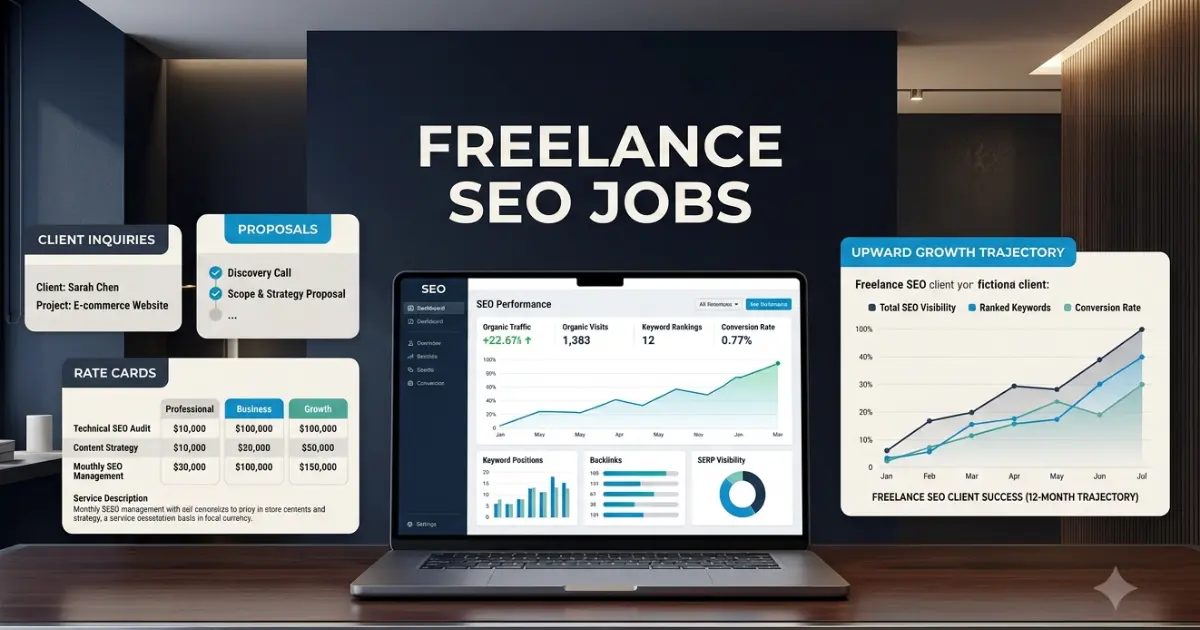
Freelance SEO isn’t a smaller version of a full-time SEO job — it’s a different job entirely. Instead of one employer setting your priorities, you’re finding your own clients, pricing your own time, and managing relationships that can end the moment a client decides to cut costs. The SEO skills matter, but they’re only half the job.
This guide covers what freelance SEO work actually looks like, how to find clients without relying on luck, how to price your services so the math actually works, and how to turn one-off projects into a stable, recurring business — not just a series of gigs.
Key Takeaways
- Freelance SEO means serving multiple clients as an independent business, not working for a single employer.
- Picking a niche — technical SEO, local SEO, AI SEO, or another focus — makes you easier to hire than a generalist.
- A portfolio and a clear proposal process do more to win clients than cold applications ever will.
- Sustainable pricing accounts for taxes, non-billable time, and business costs — not just what the “market rate” appears to be.
- The real income growth in freelance SEO comes from turning good project work into monthly retainers, not from constantly chasing new one-off clients.
Table of Contents
- What Are Freelance SEO Jobs
- Types of Freelance SEO Services & Projects
- Skills You Need to Become a Freelance SEO Professional
- Choosing Your Freelance SEO Niche
- Where to Find Freelance SEO Work & Clients
- How to Build a Freelance SEO Portfolio
- Freelance SEO Pricing: Market Benchmarks & How to Set Your Rates
- How to Write a Freelance SEO Proposal
- From Your First Client to Long-Term Retainers
- Best AI Tools for Freelance SEO
- Managing Freelance SEO Clients
- Freelance SEO vs. Remote Full-Time SEO
- Common Mistakes & Red Flags
- Freelance SEO Career Path
- Frequently Asked Questions
1. What Are Freelance SEO Jobs?
A freelance SEO job means providing SEO services to multiple clients as an independent contractor, rather than working full-time for a single employer. You set your own rates, choose your own clients, and manage your own schedule — but you’re also responsible for finding work, invoicing, and everything else that comes with running a small business.
This is meaningfully different from a remote SEO job. A remote employee gets a salary, benefits, and one set of priorities from one employer. A freelancer gets variable income, no built-in benefits, and has to balance the priorities of however many clients they’re currently serving. Neither is better — they’re different trade-offs, which we’ll compare directly in Section 12.
Freelance work typically comes in a few shapes: one-time projects (an audit, a migration, a content strategy build), fixed-term contracts (a three-month technical SEO engagement), and ongoing retainers (monthly SEO management for a recurring fee). Most freelance SEO careers involve a mix of all three, especially early on.
Who actually hires freelancers? Small and mid-sized businesses without budget for a full-time SEO hire, agencies that subcontract overflow work to trusted freelancers, startups needing SEO expertise without a long-term commitment, and larger companies bringing in a specialist for a defined project outside their in-house team’s expertise. Each of these client types wants something slightly different from you, which matters when you get to pricing and proposals later in this guide.
2. Types of Freelance SEO Services & Projects
Clients don’t hire “an SEO freelancer” in the abstract — they hire someone to solve a specific problem or deliver a specific outcome. Knowing how to package your skills into clear services makes you easier to hire and easier to price.
SEO audits. A diagnostic review of a site’s technical health, content, and backlink profile, usually delivered as a report with prioritized recommendations. Often the first project a new client hires you for, since it’s low-commitment and demonstrates your thinking before they trust you with implementation.
Keyword research and content strategy. Identifying what a business should target and building a content plan around it — topic clusters, content calendars, and briefs for writers.
Technical SEO. Diagnosing and fixing crawlability, indexing, site speed, and structured data issues. Often billed at a premium given the specialized skill required.
On-page and content optimization. Improving existing pages — titles, headers, internal linking, content depth — to perform better for target keywords.
Local SEO. Google Business Profile management, local citations, and location-specific optimization for businesses serving a specific geographic area.
E-commerce SEO. Product and category page optimization, faceted navigation cleanup, and technical work specific to online stores.
Link building. Outreach-based or digital-PR-based backlink acquisition, usually sold as a standalone service or a recurring monthly deliverable.
SEO consulting. Higher-level strategic advice — often for businesses that have an internal team but want outside expertise on direction, audits, or specific problems, rather than hands-on implementation.
AI SEO / GEO services. A growing category: optimizing content and site structure for AI Overviews and generative search visibility. Newer, less commoditized, and often priced at a premium since fewer freelancers offer it credibly yet.
| Freelance SEO Service | Typical Deliverable | Best For |
|---|---|---|
| SEO Audit | Written report with prioritized fixes | New clients, low-commitment entry point |
| Keyword Research & Content Strategy | Keyword map, content calendar, briefs | Businesses building out content |
| Technical SEO | Technical fixes and recommendations | Sites with crawl/indexing/speed issues |
| On-Page Optimization | Optimized pages, internal linking plan | Existing content underperforming |
| Local SEO | GBP optimization, citation building | Local/service-area businesses |
| E-commerce SEO | Product/category page optimization | Online stores |
| Link Building | Acquired backlinks, outreach reports | Sites needing authority growth |
| SEO Consulting | Strategic recommendations, advisory calls | Businesses with an in-house team |
| AI SEO / GEO | AI-visibility audit and optimization | Businesses concerned about AI search |
Most freelancers start by offering one or two of these clearly, then expand as they build a reputation — trying to sell all nine from day one usually reads as unfocused rather than comprehensive.
3. Skills You Need to Become a Freelance SEO Professional
Freelancing requires everything a remote employee needs, plus an additional layer of business skills nobody teaches you on the job. Here’s what actually matters, grouped by category.
Technical SEO skills. Crawling and indexing fundamentals, structured data, Core Web Vitals, and enough comfort with HTML and JavaScript behavior to diagnose issues without needing a developer to explain the basics to you. Clients hiring freelancers often expect you to be more self-sufficient than an in-house junior would be — there’s no senior teammate down the hall to double-check your work.
Content and on-page skills. Keyword research grounded in real search intent, content briefing, on-page optimization, and internal linking strategy. If you’re offering content-adjacent services, being able to evaluate (not necessarily write) strong copy matters as much as the technical side.
Business skills. This is the category most SEO courses skip entirely, and it’s often what determines whether a freelancer survives past the first year. Pricing your services sustainably (Section 7), writing proposals that win work (Section 8), invoicing, basic bookkeeping, and understanding your tax obligations as a contractor are all part of the job now, whether you enjoy that side of it or not.
Communication skills. As a freelancer, you’re often the only point of contact a client has — there’s no account manager smoothing things over. Being able to explain SEO concepts to a non-technical business owner, set realistic expectations, and deliver bad news (a ranking drop, a longer timeline) clearly and calmly is a genuine differentiator between freelancers who keep clients and freelancers who don’t.
AI and modern search skills. Understanding AI Overviews, generative search behavior, and how to use AI tools to speed up research, briefs, and reporting (Section 10 covers this in depth) is increasingly expected, not optional. Clients are asking about AI search visibility more often, and freelancers who can speak to it credibly stand out from those who can’t.
You don’t need to walk in mastering every category above. Most successful freelancers start strong in one or two — usually technical or content — and build business and communication skills through experience, often the hard way, by losing a client or underpricing a project early on and adjusting from there.
4. Choosing Your Freelance SEO Niche
Trying to sell every SEO service to every type of client is one of the most common reasons new freelancers struggle to gain traction. A clear niche makes you the obvious choice for a specific type of client, instead of one of a hundred generalists competing on price.
Technical SEO. High demand, premium pricing, and a real barrier to entry — most freelancers avoid it because it requires genuine technical depth. Good fit if you’re comfortable in crawl data, site architecture, and can hold your own in a conversation with a developer.
Local SEO. Steady, predictable demand from small businesses (contractors, clinics, restaurants, law firms) who need to rank in their area. Lower technical bar, easier to explain results clearly, and a large addressable market of small-business owners who aren’t shopping for the cheapest option — they want someone reliable.
SaaS SEO. Content- and funnel-driven, often involving comparison pages, free-tool pages, and top-of-funnel content designed to capture demand. Good fit if you understand how SEO connects to a product-led growth motion, not just rankings in isolation.
E-commerce SEO. Technical and content work at scale — product pages, category structures, faceted navigation. Good fit for freelancers comfortable with technical SEO who also want steady, recurring work, since e-commerce sites rarely “finish” their SEO needs.
AI SEO / GEO. The newest and least commoditized niche — few freelancers can speak to it credibly yet, which means less competition and stronger pricing power for those who genuinely understand it, rather than just adding “AI SEO” to a service list without substance behind it.
Content SEO. Editorial strategy, topic clusters, and content optimization. Good fit for freelancers with a writing or editorial background who understand search intent, not just SEO mechanics.
Enterprise SEO. Larger, more complex sites with multiple stakeholders and slower approval processes. Fewer freelancers pursue this niche because it demands patience and stakeholder management as much as SEO skill, but the projects tend to pay well when you land them.
International SEO. Multi-region and multi-language sites, hreflang implementation, and region-specific search behavior. A narrower niche, but one with limited competition and strong demand from companies expanding into new markets.
| Niche | Demand | Competition Among Freelancers | Best Fit For |
|---|---|---|---|
| Technical SEO | High | Low (skill barrier) | Freelancers with strong technical background |
| Local SEO | Steady, high volume | High | Freelancers wanting predictable small-business clients |
| SaaS SEO | Growing | Moderate | Freelancers who understand funnels, not just rankings |
| E-commerce SEO | High | Moderate | Technical freelancers wanting recurring work |
| AI SEO / GEO | Emerging | Very low | Freelancers ahead of the curve on AI search |
| Content SEO | Steady | High | Writers/editors with strong SEO fundamentals |
| Enterprise SEO | Moderate | Low (access barrier) | Freelancers comfortable with stakeholder management |
| International SEO | Niche | Very low | Freelancers with multi-market/language experience |
The practical advice here is simple: pick one niche to lead with in your outreach and positioning, even if you’re capable of more. You can always expand once you have a track record — starting narrow makes it far easier to get your first few clients than starting broad.
5. Where to Find Freelance SEO Work & Clients
Unlike a remote job search, freelance client acquisition isn’t just “check job boards regularly” — it’s an ongoing mix of channels, and most sustainable freelance businesses end up running two or three of these simultaneously rather than relying on just one.
Freelance marketplaces
Platforms like Upwork, Fiverr, and Contra list SEO projects directly from businesses looking to hire.
Advantages: Low barrier to entry, built-in payment protection, steady flow of new listings.
Disadvantages: Heavy price competition, a lot of low-budget or poorly scoped projects, and platform fees cutting into your rate.
Best for: Building your first few case studies and getting comfortable with client work, especially early on.
Difficulty: Low to start, but genuinely hard to earn strong, sustainable rates without differentiation — a niche (Section 4) and a solid profile matter more here than almost anywhere else.
Professional networks
LinkedIn and SEO-focused communities (Slack groups, forums, industry newsletters) where you can build visibility and connect directly with decision-makers.
Advantages: Higher-quality leads, less price competition than marketplaces, relationships that lead to repeat and referral business.
Disadvantages: Slower to produce results — this is a long-game channel, not a quick-turnaround one.
Best for: Freelancers willing to invest in visibility over months, not days.
Difficulty: Moderate — requires consistency (sharing genuine insight, not just self-promotion) more than any special skill.
Direct outreach
Identifying businesses with visible SEO problems and reaching out with specific, useful observations rather than a generic pitch.
Advantages: Highest potential rates, since you’re not competing on a public listing against dozens of other freelancers.
Disadvantages: Time-intensive, lower response rates, and easy to do badly (generic, spammy outreach gets ignored or reported).
Best for: Freelancers with a clear niche who can point to a specific, credible problem in the outreach itself — “your product pages aren’t indexed” lands very differently than “I do SEO, want to chat?”
Difficulty: High effort, but the highest ceiling on client quality and rate.
Referrals
Asking happy clients, former colleagues, and your professional network directly for introductions.
Advantages: Highest close rate of any channel — a referred lead already trusts you before the first conversation.
Disadvantages: Requires an existing base of clients or contacts, so it’s not available on day one.
Best for: Freelancers who’ve already delivered good results for at least one or two clients.
Difficulty: Low effort once available, but you have to earn access to this channel through prior work.
Agency partnerships
Web developers, designers, PPC agencies, and content agencies often need SEO support for their own clients and subcontract it out rather than hiring in-house.
Advantages: Can produce a steady stream of work without you having to find each end client yourself.
Disadvantages: Agencies typically take a margin, so your rate is often lower than working with a client directly.
Best for: Freelancers who want more predictable work volume and are comfortable trading some rate for reduced client-acquisition effort.
Difficulty: Moderate — requires building a relationship with the agency first, similar to a job application process.
Most freelancers start with marketplaces or professional networks to build initial case studies, then shift toward direct outreach and referrals as their portfolio and reputation grow — the highest-paying channels tend to be the ones that require some track record first.
6. How to Build a Freelance SEO Portfolio
A freelance portfolio has a different job than a resume: it needs to make a stranger comfortable paying you money, fast. That means leading with proof of outcomes, not a list of skills.
What belongs in a strong freelance SEO portfolio:
- 2–3 detailed case studies, each explaining the client’s starting problem, your approach, what you implemented, and the measurable result (traffic, rankings, conversions, or indexing improvements) with real data where you have it
- Before/after evidence — screenshots from Search Console or analytics showing the actual change, not just a claimed outcome
- A clear description of your specific contribution, especially if the work involved a team — clients hiring freelancers want to know what you personally did
- The tools you used, giving prospective clients a quick sense of your technical range
- Testimonials or a short quote from the client, if you have permission to share one — this does more for freelance trust-building than almost anything else on the page
Present this on a simple portfolio site, a well-organized PDF, or even a clean one-pager — the format matters less than whether a prospective client can understand what you did and what happened in under two minutes.
Building a Portfolio Without Clients Yet
Every freelancer starts with zero client case studies. A few legitimate ways to build proof before you have paying clients:
- Optimize your own website or a personal project. Apply real SEO practices and document the process and results honestly.
- Publish a public SEO audit of a well-known site (without claiming you were hired by them) to demonstrate your analytical process.
- Take on a small volunteer or discounted project for a local business or a contact in your network, specifically to generate your first real case study.
- Build a sample content strategy or keyword map for a hypothetical business, showing your research and planning process even without live implementation.
Portfolio checklist before you start outreach:
- At least one detailed case study or documented project, even if self-initiated
- Clear explanation of your process, not just the result
- Real screenshots or data where available
- A short, specific bio explaining your niche (Section 4)
- Contact information and a way to book a call or send a message
One line that matters more here than almost anywhere else in this guide: never fabricate results, invent client names, or manufacture fake testimonials. In freelance work, your reputation is the business — a discovered fabrication doesn’t just cost you one client, it can end referral chains before they start.
7. Freelance SEO Pricing: Market Benchmarks & How to Set Your Rates
Pricing is where most new freelance SEO professionals lose money without realizing it — not because they charge too little per hour, necessarily, but because they price based on what feels fair rather than what the work actually costs them to deliver.
Typical Freelance SEO Pricing Models
Hourly. You charge for time spent. Simplest to explain and invoice, but can penalize you for becoming more efficient — the faster you get at a task, the less you earn for the same value delivered. Works best for advisory work, audits, or projects with genuinely unpredictable scope.
Project-based (fixed fee). A single price for a defined deliverable — an audit, a migration, a content strategy build. Rewards efficiency and gives the client cost certainty, but requires you to scope carefully upfront, since underestimating effort means eating the difference yourself.
Monthly retainer. A recurring fee for ongoing SEO work — ideal for both sides once a relationship is established, since it gives you predictable income and gives the client continuous attention rather than a one-time fix. Section 9 covers how to actually get to this stage with a client.
Consulting/advisory rate. A premium hourly or per-session rate for strategic guidance rather than hands-on implementation — typically charged at the high end of your range, since you’re selling judgment and experience rather than execution time.
Market Benchmarks
Freelance SEO rates vary considerably by experience, niche, and client size, so treat these as a starting reference rather than a fixed answer. Generalist freelancers commonly charge $50–$100 per hour, while senior or technical specialists charge $100–$300 per hour, with $75–$150/hour being a typical range for an established, mid-career consultant. Monthly retainers generally run $750–$5,000 for local or small-business clients and $10,000–$25,000+ for enterprise engagements. One-time projects like audits or migrations typically fall between $500 and $10,000+, depending heavily on site size and scope.
These figures shift with niche, too — technical SEO and AI SEO/GEO work (Section 4) tend to command the upper end of these ranges, while broad, generalist SEO work sits closer to the lower end, simply because there’s more competition at that tier.
How to Calculate Your Own Rate
Market benchmarks tell you what’s typical — they don’t tell you what you actually need to charge to run a sustainable business. That requires working backward from your real costs, not just picking a number that sounds competitive.
Start with the income you want to earn annually, then account for what employment automatically covers but freelancing doesn’t:
- Non-billable time. Client acquisition, proposals, admin, and learning don’t generate revenue directly — realistically, only 60–75% of your working hours will ever be billable.
- Taxes. As a contractor, you’re typically responsible for self-employment tax on top of income tax, which a salaried employee doesn’t see directly on their paycheck.
- Software and tools. SEO platforms, project management tools, invoicing software — costs an employer would normally absorb.
- Benefits you’re funding yourself. Health insurance, retirement contributions, and paid time off don’t exist unless you build them into your rate.
- Business admin. Bookkeeping, contracts, and the general overhead of running a small business.
A rough framework: take your target annual income, add an estimate for taxes and business expenses, divide by your realistic billable hours per year (not your total working hours), and you’ll land closer to a rate that actually sustains the business — rather than one that looks fine on paper but leaves you working full-time hours for part-time take-home pay.
| Pricing Model | How It Works | Best For | Main Advantage |
|---|---|---|---|
| Hourly | Charge per hour worked | Advisory work, unpredictable scope | Simple to invoice |
| Project | Fixed fee for a defined deliverable | Audits, migrations, one-time builds | Predictable cost for the client |
| Retainer | Recurring monthly fee | Ongoing SEO management | Stable, recurring income |
| Consulting | Premium hourly/session rate | Strategic advisory, not implementation | Highest per-hour value |
Whatever model you use, avoid pricing purely to win the job. A rate that doesn’t account for your real costs isn’t a competitive advantage — it’s a slower path to burning out or quietly resenting the client.
8. How to Write a Freelance SEO Proposal
A proposal isn’t a formality after you’ve already won the client — for most freelance SEO work, it’s the thing that actually wins them. A clear, specific proposal signals competence before you’ve done a single hour of billable work.
A strong freelance SEO proposal typically includes:
- The client’s problem, in their own terms. Show you understood the discovery conversation — restate their actual pain point (declining traffic, poor local visibility, a recent migration gone wrong) rather than a generic SEO problem statement.
- A brief assessment of the current situation. A few specific, credible observations about their site or market — this is where a quick pre-proposal look at their site pays off, and it’s often the difference between a proposal that feels tailored and one that feels templated.
- Your proposed approach. The strategy at a high level — not a full audit given away for free, but enough to show you have a real plan, not just a willingness to “do SEO.”
- Specific deliverables. What they’ll actually receive — a report, a set of implemented fixes, a content calendar, monthly optimization work. Vague deliverables lead to scope disputes later.
- Timeline. Realistic milestones, and honesty about when results are likely to show up — SEO’s lag time is something clients often underestimate, and setting that expectation in the proposal protects you later.
- How success will be measured. Which metrics you’ll track and report on, agreed upfront so there’s no ambiguity later about whether the engagement “worked.”
- Pricing. Clearly presented, tied to the pricing model from Section 7, with no surprise line items later.
- Terms. Payment schedule, revision policy, and what happens if scope changes mid-project.
- Next steps. A specific, low-friction call to action — “reply to confirm and I’ll send over a contract” moves faster than leaving the ball entirely in their court.
A simple proposal framework to build from:
Problem → Current Situation → Proposed Approach → Deliverables → Timeline → Measurement → Pricing → Terms → Next Steps
Keep the proposal focused on what the client needs to decide, not everything you know about SEO. A proposal that reads like a textbook chapter signals inexperience more than one that’s tight, specific, and confident. And never give away your full implementation plan for free in a proposal — enough to demonstrate competence, not so much that a DIY-minded prospect can execute it without hiring you.
9. From Your First Client to Long-Term Retainers
Getting your first client and building a sustainable freelance business are two different problems. The first is about proving you can do the work; the second is about turning that proof into predictable income.
Landing Your First Client
Your first client rarely comes from the highest-paying channel — it usually comes from wherever you can get a “yes” fastest, using the acquisition channels from Section 5. That might mean starting on a marketplace, taking on a discounted project through your network, or offering a small paid audit to someone in a community you’re already part of.
A few things that make a real difference at this stage: lead with your niche (Section 4) rather than presenting as a generalist, keep the first project’s scope small and clearly defined so you can deliver confidently, and be upfront that this is early in your freelance journey rather than overselling experience you don’t have yet. Clients are often more forgiving of “I’m newer to freelancing but here’s exactly what I’ll deliver” than they are of vague overpromising that doesn’t hold up.
Don’t chase the highest possible rate on your first project. The goal is a real case study and a genuine testimonial — both are worth more to your next ten clients than an extra few hundred dollars on this one.
Delivering Results That Build Trust
Once you have a client, the work itself is what earns you the next one. That means communicating proactively rather than waiting to be asked for updates, being honest early if something isn’t working rather than burying it in a report weeks later, and documenting your process clearly enough that the client understands why something is happening, not just that it is.
Turning Projects Into Retainers
The real financial upside in freelance SEO usually isn’t landing more one-off projects — it’s converting good project work into recurring monthly retainers. The natural progression looks like this:
Audit → Implementation → Monitoring → Reporting → Ongoing Optimization
Once you’ve completed an initial audit or project and delivered real results, there’s usually a natural next conversation: SEO isn’t a one-time fix, and continued monitoring, content optimization, technical maintenance, and reporting is where ongoing value lives. This isn’t a hard upsell — it’s often a genuine continuation of the same work, framed clearly.
What a retainer conversation typically covers:
- Monthly reporting on the metrics agreed to in your original proposal
- Ongoing technical monitoring (new crawl issues, Core Web Vitals changes)
- Continued content optimization and internal linking work
- Regular search performance analysis and strategy adjustments
- A defined monthly scope, so the retainer doesn’t silently expand into unpaid extra work
Referrals: The Compounding Effect
Every well-delivered project is also a referral opportunity. After a successful engagement, asking directly — “if you know anyone else who could use this kind of help, I’d appreciate an introduction” — is a normal, professional ask, not an awkward one. Referred clients tend to close faster and negotiate less on price, since trust is already partially established before you speak.
Over time, a mix of a few retainer clients plus a steady trickle of referrals is what turns freelance SEO from a series of one-off gigs into an actual, stable business.
10. Best AI Tools for Freelance SEO
For a solo freelancer juggling multiple clients, AI tools solve a specific problem: there’s no team to split the workload with. What AI speeds up here isn’t just SEO tasks in general — it’s the specific bottlenecks that come from being one person running an entire client operation.
Research and SERP analysis. AI tools can summarize what’s currently ranking, cluster keywords by intent, and surface competitor gaps faster than manual research across multiple client accounts — useful when you’re context-switching between several niches in a single day.
Content briefs. Generating a first-pass brief for a client’s writer or for your own content work compresses a task that used to take hours into a starting draft you refine — meaningful when you’re the only person producing deliverables for every client on your roster.
Technical SEO workflows. AI-assisted interpretation of crawl data or quick flags on likely JavaScript rendering issues can speed up initial diagnosis before a deeper manual audit, which matters when you’re managing technical SEO across several sites at once.
Schema and structured data. Generating and validating structured data markup is one of the more reliably time-saving AI use cases, especially across multiple client sites with different templates.
Client reporting. Turning raw analytics into a clear, client-ready narrative is one of the most repetitive parts of freelance work — a first-draft report generated from the data, then reviewed and adjusted by you, saves real hours every month across a client roster.
Client communication. Drafting first passes of proposals, check-in emails, or explanations of technical concepts for non-technical clients — always reviewed and personalized before sending, never sent as-is.
Workflow automation. Connecting AI tools to recurring tasks — monthly report generation, rank tracking summaries — reduces the operational overhead that otherwise eats into billable time.
AI search / GEO monitoring. Tracking how client content performs in AI Overviews and generative search results is an emerging, genuinely useful application, particularly for freelancers positioning AI SEO as part of their niche (Section 4).
The limits worth being honest about: AI tools are a productivity multiplier, not a substitute for judgment. Strategy decisions, client-specific nuance, and the parts of the job clients are actually paying a human expert for still require you. Sending AI-generated content or reports to a client without review is one of the fastest ways to damage the trust a freelance relationship depends on. For a full breakdown of tools by category, see our best AI SEO tools guide and best SEO tools guide.
11. Managing Freelance SEO Clients
The SEO work itself is often the easier half of freelancing. Managing the relationship around it — expectations, scope, communication — is what determines whether a client stays for a year or churns after one project.
Setting expectations early. Before work begins, be explicit about what SEO can and can’t deliver, realistic timelines for results, and how often you’ll communicate. Most freelance client problems trace back to a mismatch between what the client expected and what was actually agreed to — and that mismatch is almost always a failure to set expectations clearly at the start, not a failure of the SEO work itself.
Contracts and scope. Even a simple contract should cover:
- Scope of work — exactly what’s included, and just as importantly, what isn’t
- Deliverables — specific outputs, not vague promises
- Payment terms — amount, schedule, and what happens with late payment
- Revision limits — how many rounds of changes are included before additional work is billed
- Timeline — start date, key milestones, and expected completion
- Cancellation terms — notice period and how partial work gets handled if a client ends the engagement early
- Confidentiality — standard for anyone with access to a client’s analytics, CMS, or business data
- Access to accounts — what platforms you’ll need access to, and for how long
- Ownership of deliverables — who owns the final work product once payment is complete
Contract and legal requirements vary by jurisdiction, so treat this as a starting checklist rather than legal advice — a template reviewed by a professional in your area is worth the one-time cost.
Communication and reporting. Set a predictable cadence (weekly check-in, monthly report) rather than reacting only when the client reaches out. Consistent, proactive communication is one of the simplest ways to differentiate yourself from freelancers who go quiet between deliverables.
Handling scope creep. The most common client-management problem in freelance SEO is quiet scope expansion — “can you also just look at…” requests that pile up outside the original agreement. Address this directly and early: acknowledge the request, note that it’s outside the current scope, and offer to quote it separately rather than either refusing outright or absorbing it for free.
Professional boundaries. Define response-time expectations (not 24/7 availability), keep communication within agreed channels, and don’t be afraid to push back professionally when a request is unreasonable. Clients generally respect freelancers who manage boundaries clearly more than those who over-accommodate and eventually burn out or resent the relationship.
Invoicing. Send invoices promptly, be clear about payment terms upfront, and don’t let overdue payments go unaddressed for too long — a polite, direct follow-up at the agreed due date is normal business practice, not an awkward confrontation.
12. Freelance SEO vs. Remote Full-Time SEO
Both paths let you do SEO work from anywhere — the real difference is in how income, stability, and control are structured, not in the work itself.
Head-to-Head Comparison
| Factor | Freelance SEO | Remote Full-Time SEO |
|---|---|---|
| Employer | Multiple clients | Usually one employer |
| Income | Variable, self-set rates | Fixed salary |
| Flexibility | High — set your own hours and workload | Depends on employer expectations |
| Client acquisition | Your responsibility | Usually the employer’s responsibility |
| Benefits | Usually self-funded | Often provided (health insurance, PTO) |
| Workload | Self-managed across multiple clients | Employer-defined, one set of priorities |
| Career path | Business growth, consulting, agency | Structured progression (Specialist → Manager) |
Which One Fits You?
| If you prefer… | Consider… |
|---|---|
| A stable, predictable salary | Remote full-time SEO |
| Setting your own schedule and workload | Freelance SEO |
| Building and owning a business | Freelance SEO |
| Reporting to one employer with clear priorities | Remote full-time SEO |
| Working with a variety of clients and industries | Freelance SEO |
| Employer-provided benefits and structured career progression | Remote full-time SEO |
Neither path is a strictly better career move — they suit different risk tolerances and different life circumstances. Many SEO professionals move between the two over a career: starting full-time to build skills and a portfolio, freelancing for a period to gain independence and higher earning potential, and sometimes returning to full-time employment later for stability, especially around major life changes.
If full-time remote employment sounds like the better fit for where you are right now, our complete guide to remote SEO jobs covers the roles, skills, salaries, and hiring process for that path in depth.
13. Common Mistakes & Red Flags
Most freelance SEO problems fall into one of two categories: things freelancers do to themselves, and warning signs about clients that get ignored until they become expensive. Worth treating as two separate checklists.
Mistakes Freelancers Make
Charging too little. Underpricing to win work feels safe early on, but it attracts price-sensitive clients, makes it harder to raise rates later, and often means working unsustainable hours for the income you’re generating.
Taking every client who says yes. Not every lead is worth pursuing. A client outside your niche, with unrealistic expectations, or with an obviously difficult personality in the first conversation is rarely worth the discount rate or the stress.
Skipping a contract. Even a simple one-page agreement protects both sides. Working without one — especially early on, when it feels like it might scare off a client — is one of the most common sources of unpaid work and scope disputes.
Promising rankings. No freelancer controls Google’s algorithm. Promising specific ranking positions or timelines sets you up to either miss the promise or feel pressured into black-hat shortcuts to try to hit it.
Using black-hat tactics under client pressure. A client pushing for quick wins through manipulative tactics is putting your professional reputation at risk, not just their own site — and results that violate search engine guidelines can be reversed or penalized, damaging the client relationship anyway.
Poor or inconsistent reporting. Clients who don’t understand what you’re doing or why start to doubt the value of the engagement, even when the work is genuinely good. Reporting isn’t overhead — it’s part of the deliverable.
Over-relying on AI without review. Sending AI-generated reports, content, or client communication without a human review pass is one of the fastest ways to damage trust once a client notices.
No specialization. Generalist positioning makes you compete on price against everyone else offering “SEO services.” A clear niche (Section 4) is one of the simplest fixes for this.
No system for finding new clients. Relying entirely on one client or one channel leaves you exposed if that relationship ends. A mix of channels (Section 5) protects against feast-or-famine cycles.
Red Flags in Potential Clients
Requests for extensive unpaid work upfront. A short, paid test project is reasonable. An “unpaid trial audit” or open-ended “show us what you’d do first” request usually isn’t.
Unrealistic expectations from the first conversation. A prospect expecting first-page rankings in weeks, or dismissing the time SEO genuinely takes, is often a difficult client relationship before you’ve even started.
Pressure toward black-hat tactics. A client asking for bulk link purchases, cloaking, or other guideline-violating tactics is a clear signal to walk away, regardless of the rate offered.
Payment problems early on. Slow or resistant payment during the proposal or contract stage is a strong predictor of ongoing payment issues once work begins.
Scope that keeps expanding before work even starts. If a client is already adding “just one more thing” during the proposal stage, that pattern rarely improves once the contract is signed.
Suspicious access requests. Requests for account access, payment details, or credentials that go beyond what the project genuinely requires are worth questioning before proceeding.
Trusting your instincts matters here. Most freelance SEO relationships are entirely legitimate and professional — but the pattern-recognition built from a few difficult clients is exactly what helps you spot the next one earlier.
14. Freelance SEO Career Path
Freelance SEO careers don’t follow a fixed ladder the way in-house roles often do, but there’s a recognizable progression most freelancers move through as they build experience and reputation.
Beginner. Focused on learning SEO fundamentals, building an initial portfolio (Section 6), and landing the first few clients through marketplaces, network contacts, or discounted projects. Pricing is usually on the lower end at this stage, and the primary goal is real case studies and testimonials, not maximizing income yet.
Intermediate. A clearer niche has emerged (Section 4), client quality improves through referrals and a stronger portfolio, and pricing starts to reflect real market rates rather than beginner discounts. Retainers begin replacing one-off projects as the primary income source, and the business starts to feel more predictable month to month.
Advanced. Deeper specialization, higher-value projects, and often a shift toward consulting and strategic advisory work rather than hands-on execution for every deliverable. Some freelancers at this stage bring on subcontractors for overflow work, effectively becoming a very small agency without fully committing to that structure yet.
Expert. A few directions tend to open up here: formalizing into a full SEO consultancy or agency, building productized services (fixed-scope, fixed-price offers rather than fully custom engagements), or moving into training, courses, or education built on established expertise and reputation.
Not every freelancer wants to progress through all four stages — plenty of experienced freelancers deliberately stay at “advanced,” preferring hands-on client work over the overhead of building an agency. There’s no single correct endpoint; the useful thing to know is that the path exists if and when you want to grow beyond solo freelancing.
Frequently Asked Questions
Independent, project- or contract-based SEO work performed for multiple clients rather than a single employer — you set your own rates, choose your clients, and manage your own business operations alongside the SEO work itself.
Through a mix of channels — freelance marketplaces, professional networks, direct outreach, referrals, and agency partnerships. Most freelancers use two or three of these simultaneously rather than relying on just one. Full breakdown in Section 5.
Yes, though you’ll need to build proof of skill without client case studies first — through your own website, public audits, or discounted early projects. See Section 6 for specifics.
It varies by niche and experience — generalists typically charge $50–$100/hour, while senior or technical specialists charge $100–$300/hour. Monthly retainers commonly range from $750 to $25,000+ depending on client size. Full breakdown in Section 7.
It offers real upside — flexibility, higher earning potential over time, and control over your work — but with income variability and no built-in benefits. Whether it’s worth it depends on your risk tolerance and where you are in your career; Section 12 compares it directly against remote full-time SEO.
No single best source — marketplaces are easiest to start with, while direct outreach and referrals tend to produce higher-paying, longer-term relationships once you have some track record. Section 5 breaks down which channel fits which stage.
Audits, technical SEO, content strategy, on-page optimization, local SEO, e-commerce SEO, link building, consulting, and increasingly AI SEO/GEO work. Most freelancers lead with one or two rather than offering everything at once — see Section 2.
Usually through whichever channel produces a “yes” fastest — a marketplace listing, a discounted project through your network, or a small paid audit. The goal early on is a real case study and testimonial, not the highest possible rate. Section 9 covers this in detail.
Depends on the work — hourly suits unpredictable or advisory work, project-based suits clearly defined deliverables, and retainers work best once a relationship is established. Section 7 explains how to choose and how to calculate your actual rate.
Yes, and most freelancers should — AI tools speed up research, briefs, and reporting significantly. The key is always reviewing AI output before it reaches a client; sending unreviewed AI work is one of the fastest ways to damage client trust. Section 10 covers specific use cases.