The Search Game Has Already Changed
Let me ask you something—
When was the last time you clicked through 5 blue links on Google to find an answer?
Exactly.
Today, tools like ChatGPT, Gemini, and Perplexity don’t just show links…
They generate answers instantly.
That shift changes everything.
- Users don’t search → they ask
- They don’t browse → they consume answers
- They don’t click → they trust summarized content
👉 And here’s the opportunity most creators are missing:
If your content is not optimized for AI-generated answers, you’re invisible—even if you rank on Google.
At techecom.com, we’ve been closely analyzing this shift. And one thing is clear:
Generative Engine Optimization (GEO) is not the future—it’s already happening.
In this guide, I’ll walk you through:
- What GEO actually is (in simple terms)
- How AI search engines work behind the scenes
- And most importantly, how you can rank inside AI answers—not just search results
By the end, you won’t just understand GEO…
👉 You’ll know exactly how to apply it like a pro.
SEO/GEO tips of the day:
Putting Quick Answers near the top helps you:
-> Capture featured snippets
-> Rank for voice search queries
-> Improve UX for impatient readers
Google loves content that answers questions immediately.
“AI search engines don’t cite who is the ‘most popular’; they cite who is the ‘most useful’ to their math.”
🟢 What is Generative Engine Optimization (GEO)?
🔹 Simple Definition (No Jargon)
Generative Engine Optimization (GEO) is the process of optimizing your content so that AI tools (like ChatGPT or Gemini) can find, understand, and include it in their generated answers.
In simple terms:
GEO = Making your content “AI-readable, AI-trustworthy, and AI-selectable.”
The “Citation Magnet” Secret: Tone Matters More Than You Think
Most marketers make the mistake of writing content that sounds like a sales pitch. But in the world of Generative Engine Optimization (GEO), “salesy” language is a citation killer.
Recent analysis of how LLMs select their sources shows a massive bias toward objective, declarative language.
If you want an AI search engine to cite you, you have to stop “suggesting” and start “declaring.” The AI isn’t looking for your opinion; it’s looking for a source it can use as evidence.
The Shift: Opinion vs. Authority
- Don’t say: “We think that using WebP images might help your site speed because they are smaller.” (This is too passive and subjective).
- Do say: “The data shows that WebP images reduce payload size by up to 30% compared to JPEGs, directly improving Core Web Vitals.”
What Google’s AI Search Guidelines Mean for GEO (2026 Update)
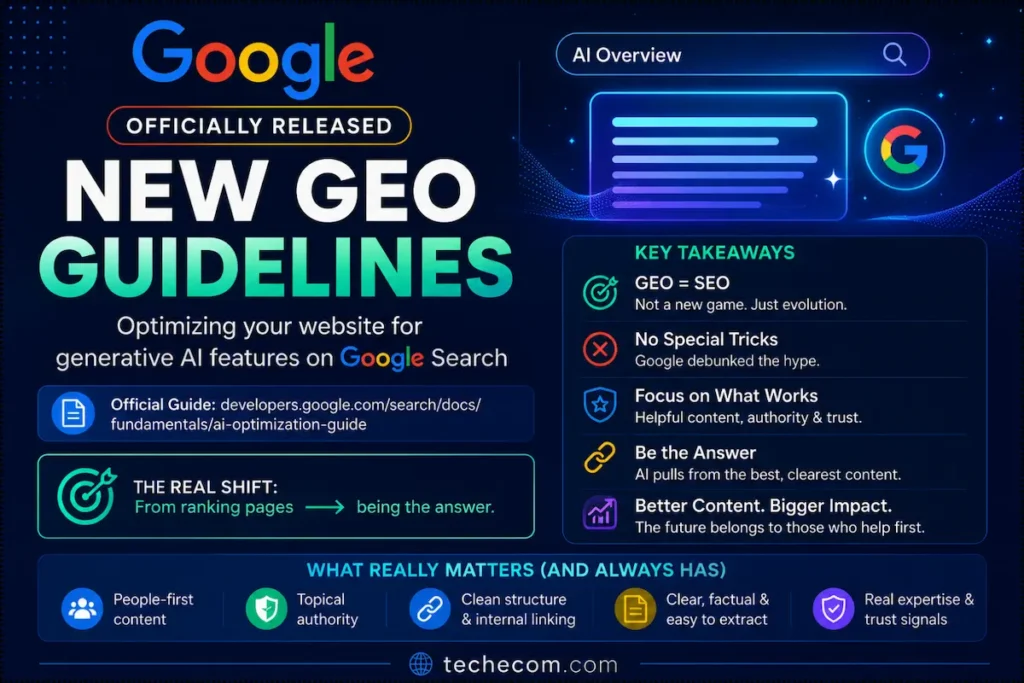
Quick takeaway:
Google made it clear—optimizing for AI search isn’t about new tricks. It’s about doing SEO right, with clarity, credibility, and real value.
Let’s simplify what actually changed.
GEO Isn’t a New System—It’s SEO Evolving
Google confirmed that AI features like AI Overviews are still powered by the same core ranking systems.
That means:
- No separate “AI algorithm”
- No special optimization framework
- No shortcuts
If your SEO fundamentals are strong, you’re already aligned.
What Google Explicitly Says You Don’t Need
There’s a lot of noise around GEO—but Google cleared it up:
- You don’t need llms.txt or AI-specific files
- You don’t need content chunking hacks
- You don’t need to rewrite content for AI systems
AI search understands context naturally. Focus on users, not tricks.
The Real Shift: From Ranking Pages → Being Selected
Traditional SEO = rank higher
AI search = get selected as a source
AI doesn’t show 10 blue links first—it builds an answer using multiple sources.
So your content must be:
- Clear enough to extract
- Accurate enough to trust
- Useful enough to cite
EEAT Is Now a Visibility Filter
AI systems prioritize content that shows:
- Real experience
- Clear expertise
- Strong authority
- Trust signals
Google also emphasizes that content must be original, helpful, and written for people, not just search engines.
And yes—AI-generated content is fine…
👉 but only if it adds real value and is reviewed by humans.
What Actually Works (Right Now)
If you do only these things, you’re ahead of 90% of sites:
- Answer questions clearly and directly
- Structure content for easy scanning
- Add original insights or experience
- Build topical authority (not random posts)
- Show credibility (author, sources, updates)
Because in AI search:
You don’t win by ranking.
You win by being the best answer available.
Bottom Line
GEO isn’t a loophole or hack.
It’s a shift toward:
- Better content
- Clearer answers
- Stronger trust
And the sites that focus on that?
👉 They’re the ones AI systems choose to cite.
Read full news update from Google Here: Google released officially “Optimizing your website for generative AI features on Google Search”
🔹 Why GEO Matters More Than SEO in 2026
Let’s break this down logically.
Traditional SEO focuses on:
- Ranking in search engines
- Getting clicks
- Driving traffic
But GEO focuses on:
- Being quoted inside AI answers
- Becoming a source of truth
- Earning visibility without clicks
👉 That means:
- Your content can be used by AI tools
- Your brand gets mentioned
- Your authority grows—even without direct traffic
And here’s the kicker:
One mention in an AI answer can outperform 100 traditional clicks.
🔹 The Shift: From Search Engine → Answer Engine
We are moving from:
Search Engine Optimization (SEO)
➡️ to
Answer Engine Optimization (AEO)
➡️ to
Generative Engine Optimization (GEO)
This is not a trend—it’s an evolution.
🟢 GEO vs SEO vs AEO: What’s the Real Difference?
Let’s make this crystal clear.
🔹 Traditional SEO (What You Already Know)
- Focus: Ranking on Google SERPs
- Goal: Traffic
- Method: Keywords, backlinks, technical SEO
👉 Limitation:
Even if you rank #1, AI tools may still ignore your content
🔹 Answer Engine Optimization (AEO)
- Focus: Featured snippets, voice search
- Goal: Quick answers
- Method: Structured Q&A content
👉 Limitation:
Still dependent on search engines like Google
🔹 Generative Engine Optimization (GEO)
- Focus: AI-generated answers
- Goal: Being included in AI responses
- Method: Context-rich, structured, trustworthy content
🔹 Quick Comparison Table (Snippet Optimized)
| Factor | SEO | AEO | GEO |
|---|---|---|---|
| Platform | Google + Voice | AI Tools | |
| Goal | Clicks | Quick Answers | AI Mentions |
| Content Style | Keyword-focused | Q&A format | Context-rich + structured |
| Output | Links | Snippets | Generated Answers |
| Future Relevance | Medium | High | Very High |
🟢 How AI Search Engines Actually Work (Behind the Scenes)
To win at GEO, you need to understand one thing:
AI doesn’t “rank pages”—it selects and synthesizes information.
Let’s break it down step by step.
🔹 Step 1: Content Discovery
AI models pull data from:
- Indexed web pages
- High-authority sites
- Structured content repositories
👉 If your content is not well-structured, it may never be picked.
🔹 Step 2: Context Understanding
AI evaluates:
- Topic relevance
- Semantic meaning
- Depth of explanation
This is where semantic SEO + topical authority matter.
🔹 Step 3: Answer Generation
Instead of showing links, AI:
- Combines multiple sources
- Extracts key insights
- Generates a clean answer
👉 Your goal is to become one of those “sources”
🔹 Step 4: Source Attribution (Sometimes)
Some platforms (like Perplexity) cite sources.
Others may not explicitly link—but still use your content.
👉 Either way, authority builds silently
🟢 The GEO Mindset: Stop Writing for Google Alone
Here’s the mistake most bloggers are making:
They are still writing for search engines—not for AI systems.
Let’s fix that.
🔹 Old Approach (Outdated)
- Keyword stuffing
- Long intros
- Clickbait titles
- Writing for bots
🔹 New GEO Approach (Winning Strategy)
- Clear, direct answers
- Structured content (H2, H3, lists)
- Context-rich explanations
- Human + AI-friendly writing
🔹 The Golden Rule of GEO
If an AI cannot easily extract your answer in 5–10 seconds… you won’t get featured.
🟢 Core Principles of Generative Engine Optimization
Before we jump into strategies, you need to lock these fundamentals:
🔹 1. Clarity Beats Creativity
AI prefers:
- Simple language
- Direct answers
- Clean structure
Not:
- Fancy words
- Long storytelling
🔹 2. Structure = Visibility
Use:
- Headings (H1–H3)
- Bullet points
- Tables
- FAQs
👉 This makes extraction easier
🔹 3. Context Depth Wins
Don’t just answer “what”
👉 Also explain “why” and “how”
🔹 4. Authority Signals Matter
Include:
- Real examples
- Data points
- Experience-based insights
🔹 5. Freshness is a Ranking Factor
AI prefers:
- Updated content
- Recent insights
- Current trends
🚀 Part 2: 10+ Proven Generative Engine Optimization (GEO) Strategies to Rank in AI Search
🔥 Strategy 1: Write Direct, Answer-First Content (The #1 GEO Rule)
AI tools don’t “read” like humans—they scan for answers.
So if your content hides the answer in long paragraphs, you lose.
✅ How to Execute
- Start sections with a direct answer (2–3 lines)
- Then expand with explanation
- Use question-based headings
💡 Example
❌ Weak:
“In today’s digital landscape, optimizing content is very important…”
✅ Strong:
Generative Engine Optimization (GEO) is the process of optimizing content so AI tools can include it in generated answers.
🎯 Pro Tip
At techecom.com, always follow:
Answer → Explain → Expand
🔥 Strategy 2: Use Structured Content That AI Can Extract Easily
Structure is not design—it’s data for AI.
✅ Use This Format
- H2 → Main topic
- H3 → Subtopics
- Bullet points → Key ideas
- Tables → Comparisons
💡 Why It Works
AI prefers:
- Organized content
- Clearly separated ideas
- Easy-to-scan sections
🎯 Quick Win
Add:
- “Definition boxes”
- “Quick summaries”
- “Step-by-step sections”
🔥 Strategy 3: Optimize for Featured Snippets AND AI Answers
Here’s a powerful insight:
Content that wins featured snippets often gets picked by AI.
- 40–60 word paragraphs
- Numbered lists
- Tables
💡 Example Snippet Format
What is GEO?
Generative Engine Optimization (GEO) is the practice of optimizing content for AI-driven search tools so it can be included in generated answers.
🎯 Action Step
For every major section:
- Add a mini-answer block
🔥 Strategy 4: Use Semantic SEO + Topic Clusters
AI doesn’t rely on keywords alone—it understands context.
✅ What to Do
Instead of targeting:
- “GEO strategies”
Also include:
- AI search optimization
- answer engine optimization
- AI ranking factors
- content optimization for ChatGPT
💡 Why This Works
You’re building:
Topical Authority → Higher AI Trust → More Mentions
🎯 Techecom Strategy
Create clusters like:
- GEO basics
- GEO tools
- GEO case studies
- GEO vs SEO
🔥 Strategy 5: Add High-Quality FAQs (AI Loves This)
FAQs are gold for GEO.
✅ How to Do It
- Add 5–8 real user questions
- Keep answers concise (40–80 words)
- Use natural language
💡 Example
A: To optimize content for AI search engines, focus on clear answers, structured formatting, semantic keywords, and authoritative insights that AI systems can easily extract and trust.
🎯 Bonus
Add FAQ schema → increases visibility
🔥 Strategy 6: Build E-E-A-T (Experience, Expertise, Authority, Trust)
AI systems prioritize credible content.
✅ How to Build It
- Add author bio
- Share real experience
- Link to trusted sources
- Show practical insights
💡 Example
Instead of:
“Experts say…”
Write:
“Based on our testing at techecom.com…”
🎯 Result
You become:
A source AI trusts—not just another blog
🔥 Strategy 7: Use Data, Stats, and Real Examples
AI prefers factual, verifiable content.
✅ Add
- Industry stats
- Case studies
- Real-world examples
💡 Example
Blogs with structured content are more likely to be extracted by AI systems compared to unstructured content.
🎯 Pro Tip
Even small data points increase:
- Trust
- Extractability
- Authority
🔥 Strategy 8: Optimize for Conversational Queries
AI queries are not like Google queries.
🔍 Users Ask:
- “How do I rank in AI search?”
- “What is GEO?”
- “Is SEO dead?”
✅ Your Job
Match this style:
- Write naturally
- Use conversational tone
- Answer like a human expert
🎯 Framework
Use:
Question → Direct Answer → Explanation
🔥 Strategy 9: Keep Content Fresh and Updated
AI prefers recent and relevant content.
✅ Update Strategy
- Refresh content every 3–6 months
- Add new trends (AI updates)
- Update examples
💡 Why It Matters
Outdated content =
❌ Ignored by AI
❌ Reduced authority
🎯 Techecom Move
Add:
“Updated for 2026 AI Search Trends”
🔥 Strategy 10: Build Brand Mentions & Digital Authority
This is underrated—but powerful.
✅ What to Do
- Publish on multiple platforms
- Get mentioned in blogs
- Build presence on LinkedIn
💡 Why It Works
AI trusts:
Recognized entities over unknown websites
🎯 Goal
Make techecom.com a known brand in:
- AI
- SEO
- Digital marketing
🔥 Strategy 11: Use Internal Linking to Strengthen Context
AI analyzes your entire site—not just one page.
✅ Link To:
- Related blog posts
- Topic clusters
- Supporting guides
💡 Example
From this post, link to:
- AI tools guide
- SEO strategies
- Content marketing
🎯 Result
You build:
Topical depth + AI confidence
🔥 Strategy 12: Format Content for Skimmability (Critical)
If humans can’t scan it, AI won’t either.
✅ Use
- Short paragraphs (2–3 lines)
- Bold key points
- Lists and spacing
💡 Rule
One idea per paragraph
🔥 Strategy 13: Add Unique Insights (Your Secret Weapon)
Most AI-generated content is generic.
You win by being:
Specific + original + experience-driven
✅ Add
- Personal insights
- Observations
- Predictions
💡 Example
At techecom.com, we’ve observed that answer-first content consistently performs better in AI-generated responses than long-form storytelling intros.
🧠 Mini Recap (Important)
If you implement just these, you’re ahead of 90% creators:
- Answer-first writing
- Structured content
- Semantic depth
- FAQs
- Authority signals
- Fresh updates
Advanced GEO Execution, Checklist, Tools & Future Strategy
🟢 Generative Engine Optimization (GEO) Checklist (Actionable)
If you only remember one section from this entire guide—make it this.
Use this as your pre-publish + post-update checklist for every blog on techecom.com.
✅ 🧩 Content Structure Checklist
- Clear H1 with primary keyword
- Logical H2–H3 hierarchy
- Each section starts with a direct answer
- Short paragraphs (2–3 lines max)
- Bullet points and numbered lists included
- At least 1 comparison table
👉 Goal: Make content machine-readable + human-friendly
✅ 🧠 Content Quality Checklist
- Answers are clear and concise
- Covers “What + Why + How”
- Includes semantic keywords (not stuffing)
- Uses conversational, natural language
- Includes real insights (not generic AI text)
✅ 🏆 Authority & Trust (E-E-A-T)
- Author bio added
- Experience or observations included
- Credible outbound references (if needed)
- No misleading or vague claims
✅ 🔍 GEO Optimization Checklist
- Question-based headings included
- Featured snippet blocks added
- FAQ section (5–8 questions)
- Conversational queries targeted
- Updated for latest year (2026)
✅ 🔗 Internal Linking Checklist
- Links to 3–5 relevant blog posts
- Anchor text is natural and contextual
- Supports topic clusters
✅ 🔄 Freshness & Update Checklist
- Add “Last updated” date
- Refresh stats and examples
- Improve sections based on new AI trends
Best Tools for Generative Engine Optimization in 2026
Let’s be practical—you don’t need 20 tools. You need the right stack.
🔹 1. AI Content Optimization Tools
Use these to structure and refine content:
- ChatGPT (for drafting + refining answers)
- Claude (for depth and clarity
👉 Use wisely:
AI should assist—not replace your expertise
🔹 2. Keyword & Topic Research Tools
- Google Keyword Planner
- Ahrefs / SEMrush
- AlsoAsked (great for questions)
👉 Focus:
- Long-tail queries
- Conversational keywords
🔹 3. AI Search Monitoring Tools
- Perplexity (check if your content gets cited)
- Google SGE (Search Generative Experience insights)
👉 Strategy:
Search your topic and see:
Are competitors being used in AI answers?
🔹 4. Content Structuring Tools
- Surfer SEO
- Frase
👉 Helps with:
- Headings
- NLP keywords
- Content depth
🟢 Common GEO Mistakes to Avoid (Critical)
Let’s save you months of wasted effort.
❌ Mistake 1: Writing Only for Google Rankings
Reality:
Ranking #1 ≠ Being used by AI
Fix:
- Write for answers, not just keywords
❌ Mistake 2: Long, Fluffy Introductions
AI skips fluff.
Fix:
Get to the point within 2–3 lines
❌ Mistake 3: Poor Structure
Big paragraphs = zero extraction.
Fix:
- Break everything into sections
❌ Mistake 4: Overusing AI Without Editing
Generic content = low trust.
Fix:
- Add human insights, examples, opinions
❌ Mistake 5: Ignoring Updates
Old content dies fast in AI search.
Fix:
Refresh regularly
🟢 Future of SEO: Is GEO Replacing Traditional SEO?
Let’s be honest and strategic here.
🔹 Is SEO Dead?
No.
But it is evolving fast.
🔹 What’s Actually Happening?
We are moving toward:
- Search engines → Answer engines
- Keywords → Context
- Traffic → Visibility + authority
🔹 The Smart Approach
Don’t choose between SEO and GEO.
👉 Combine both:
- SEO → brings traffic
- GEO → builds authority in AI
🔹 What You Should Do in 2026
- Optimize for Google and AI tools
- Focus on topical authority
- Build brand trust
🟢 How to Future-Proof Your Content Strategy (Techecom Blueprint)
Here’s a simple but powerful system you can follow:
🔹 Step 1: Pick a Core Topic
Example:
- Generative Engine Optimization
🔹 Step 2: Build Topic Clusters
Create posts like:
- GEO basics
- GEO tools
- GEO strategies
- GEO case studies
🔹 Step 3: Interlink Everything
This creates:
Topical authority → Higher AI trust
🔹 Step 4: Update Regularly
Add:
- New AI developments
- Updated strategies
🔹 Step 5: Distribute Content
- Medium
👉 Build brand signals for your website
🟢 Conclusion: The Real Opportunity Most People Will Miss
Let’s close this honestly.
Most creators will:
- Keep focusing only on SEO
- Ignore AI search
- Lose visibility over time
But you won’t—because now you understand this:
The future belongs to content that AI can trust, extract, and recommend.
🎯 Final Takeaways
- Write answer-first content
- Structure everything clearly
- Build topical authority
- Add real insights
- Stay updated
🚀 Your Next Move
Don’t just read this—apply it.
Start with:
- One blog post
- Optimize it using this guide
- Track results in AI search tools
At techecom.com, we’re not just adapting to the future of search—
👉 we’re building for it.
🟢 FAQs: Generative Engine Optimization (GEO)
Generative Engine Optimization (GEO) is the process of optimizing content so AI tools can include it in generated answers, improving visibility beyond traditional search rankings.
SEO focuses on ranking in search engines, while GEO focuses on being included in AI-generated responses and answer-based systems.
Use structured content, answer-first writing, semantic keywords, FAQs, and authority signals to make your content AI-friendly.
Yes. GEO helps bloggers gain visibility in AI tools, even without relying solely on Google traffic.
Tools like ChatGPT, Surfer SEO, Ahrefs, and Perplexity help with content creation, optimization, and monitoring AI visibility.