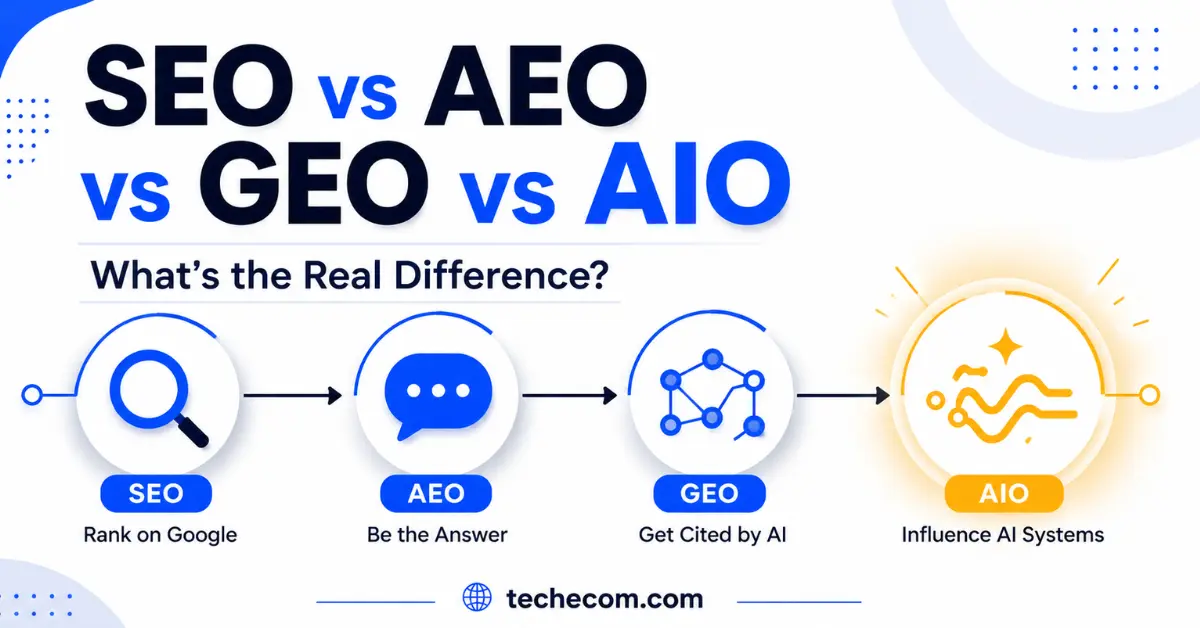
If you’re wondering about SEO vs AEO vs GEO vs AIO, here’s the simple answer: all four are search strategies, but each focuses on a different way people find information today.
SEO (Search Engine Optimization) helps your content rank on Google through keywords, backlinks, and technical optimization.
AEO (Answer Engine Optimization) focuses on getting your content picked as direct answers for voice search and featured snippets.
GEO (Generative Engine Optimization) is about optimizing content for AI-driven search tools like ChatGPT or Google SGE.
AIO (AI Optimization) goes a step further by aligning your content with how AI understands, summarizes, and recommends information.
At techecom.com, we see a clear shift: search is no longer just about ranking—it’s about being the best answer across search engines, voice assistants, and AI platforms. So, while SEO builds your foundation, AEO, GEO, and AIO help you stay visible in the future of search.
In short, we don’t choose one—we combine all four to win traffic, trust, and conversions in 2026 and beyond.
SEO vs AEO vs GEO vs AIO: Quick Comparison
If you want a fast breakdown, here’s how we can understand all four:
- SEO = Optimize for search engines (Google rankings)
- AEO = Optimize for direct answers (featured snippets, voice search)
- GEO = Optimize for AI-generated responses (ChatGPT, Google SGE)
- AIO = Optimize for how AI understands and recommends content
Now, here’s the real difference:
| Strategy | Focus | Goal | Where You Show Up |
|---|---|---|---|
| SEO | Keywords + backlinks | Rank on Google | Search results (SERPs) |
| AEO | Questions + answers | Get featured answers | Snippets, voice assistants |
| GEO | AI-friendly content | Appear in AI responses | ChatGPT, SGE |
| AIO | AI understanding | Be recommended by AI | AI tools, smart systems |
So, instead of competing, these strategies work together.
At techecom.com, we approach it like this:
👉 SEO brings traffic
👉 AEO captures attention
👉 GEO builds AI visibility
👉 AIO drives long-term relevance
In 2026, relying only on SEO means missing a huge part of how users actually search today.
What Is SEO in 2026? (And Why It Still Matters)
SEO (Search Engine Optimization) is still the foundation of online visibility—but in 2026, it’s no longer just about keywords.
Today, SEO means helping search engines understand, trust, and rank your content based on real value.
🔑 What SEO Actually Includes Now
- Search intent matching (not just keywords)
- High-quality, helpful content (EEAT: Experience, Expertise, Authority, Trust)
- Technical performance (page speed, mobile-first, core web vitals)
- Authority signals (backlinks, brand mentions)
- User experience (engagement, time on page, bounce rate)
📈 What SEO Does for You
When we use SEO правильно at techecom.com, it helps us:
- Rank on Google search results
- Drive consistent, passive traffic
- Build long-term authority in our niche
- Monetize through ads, affiliates, and products
⚠️ The Reality in 2026
Here’s the shift:
Ranking #1 on Google doesn’t guarantee clicks anymore.
Why? Because users now get answers from:
- Featured snippets
- Voice assistants
- AI tools like ChatGPT
That’s why SEO alone is not enough.
✅ Bottom Line
SEO brings people to your content.
But if you want to own attention and visibility across platforms, you need AEO, GEO, and AIO working with it—not instead of it.
What Is AEO (Answer Engine Optimization)?
AEO (Answer Engine Optimization) is about structuring your content so it becomes the direct answer to user questions.
Instead of just ranking on Google, AEO helps your content get picked for:
- Featured snippets (“position zero”)
- Voice search results (Alexa, Google Assistant)
- “People Also Ask” sections
🔑 What AEO Focuses On
- Clear, direct answers to specific questions
- FAQ-style content (who, what, why, how)
- Structured formatting (headings, lists, tables)
- Schema markup (FAQ, HowTo, Q&A)
- Concise explanations (40–60 words for snippe
📈 What AEO Does for You
At techecom.com, AEO helps us:
- Capture instant visibility above search results
- Increase click-through rates (CTR)
- Build authority and trust quickly
- Get traffic from voice and zero-click searches
⚠️ The Reality in 2026
Users don’t always click anymore—they want instant answers.
If your content is not optimized for AEO:
- Google may answer the query without you
- Your competitors may take the snippet
- You lose visibility even if you rank
✅ Bottom Line
SEO helps you rank.
AEO helps you own the answer.
If you’re not structuring your content for answers, you’re missing one of the fastest ways to win traffic in 2026.
What Is GEO (Generative Engine Optimization)?
GEO (Generative Engine Optimization) is about optimizing your content so it gets used and cited by AI tools like ChatGPT, Google SGE, and other generative search systems.
Instead of ranking links, these platforms generate answers—and GEO helps your content become part of those answers.
🔑 What GEO Focuses On
- Topical authority (deep coverage of a subject)
- EEAT signals (Experience, Expertise, Authority, Trust)
- Semantic relevance (covering related concepts, not just keywords)
- Clear, factual writing (easy for AI to extract and summarize)
- Brand mentions + credibility
📈 What GEO Does for You
At techecom.com, GEO helps us:
- Get mentioned or cited in AI-generated answers
- Build brand visibility without clicks
- Reach users who rely on AI instead of Google
- Future-proof content for evolving search behavior
⚠️ The Reality in 2026
Search is shifting from “10 blue links” to AI-generated summaries.
That means:
- Users may never visit search results
- AI chooses which sources to trust
- Only credible, well-structured content gets included
If your content lacks authority or depth, AI simply ignores it.
✅ Bottom Line
SEO helps you rank.
AEO helps you answer.
GEO helps you become the source AI trusts.
If you want visibility in the AI search era, GEO is no longer optional—it’s essential
What Is AIO (AI Optimization)?
AIO (AI Optimization) is about creating content that not only ranks or answers—but is understood, trusted, and recommended by AI systems.
It goes beyond GEO.
While GEO helps you get cited, AIO helps you influence how AI interprets and delivers information.
🔑 What AIO Focuses On
- Human-first expertise (real insights, not generic content)
- AI-assisted scaling (using AI tools without losing quality)
- Context-rich content (clear explanations, examples, depth)
- Trust signals (author credibility, consistency, accuracy)
- Content structure AI can learn from
📈 What AIO Does for You
At techecom.com, AIO helps us:
- Build long-term authority across AI platforms
- Increase chances of being recommended, not just cited
- Stay competitive as AI becomes the primary interface
- Scale content while maintaining quality + trust
⚠️ The Reality in 2026
AI is no longer just a tool—it’s becoming the gatekeeper of information.
That means:
- AI decides what content gets surfaced
- Generic, AI-written content gets filtered out
- Only authentic, experience-driven content stands out
If your strategy is only “publish more,” you lose.
If your strategy is “publish better,” you win.
✅ Bottom Line
SEO brings traffic.
AEO captures answers.
GEO earns citations.
AIO ensures you stay relevant, trusted, and recommended in an AI-first world.
This is not optional anymore—it’s the direction search is heading.
SEO vs AEO vs GEO vs AIO: Key Differences Explained Simply
If you’re still confused, let’s break this down in the simplest way possible:
🔍 The Core Difference
- SEO = Helps your page rank on search engines
- AEO = Helps your content become the direct answer
- GEO = Helps AI tools use and cite your content
- AIO = Helps AI understand and recommend your content
🧠 How Each One Thinks
- SEO thinks: “How do I rank higher?”
- AEO thinks: “How do I answer this question clearly?”
- GEO thinks: “How do I become a trusted AI source?”
- AIO thinks: “How do I stay relevant in an AI-driven world?”
⚙️ Strategy Difference
- SEO focuses on search engines
- AEO focuses on answers
- GEO focuses on AI-generated results
- AIO focuses on AI understanding + influence
📍 Where You Appear
- SEO → Google search results
- AEO → Featured snippets, voice assistants
- GEO → AI answers (ChatGPT, SGE)
- AIO → AI recommendations, summaries, smart systems
⚡ The Real Insight (Most Important)
These are not separate strategies anymore.
They are layers of the same system:
- SEO is the foundation
- AEO captures attention
- GEO builds AI visibility
- AIO secures future dominance
✅ Bottom Line
If you only focus on SEO, you compete for rankings.
But when you combine SEO + AEO + GEO + AIO, you:
- Rank on Google
- Own featured answers
- Get cited by AI
- Stay visible everywhere users search
That’s the real difference—and the real opportunity in 2026.
Which Strategy Should You Focus On in 2026?
The honest answer: you shouldn’t choose just one.
In 2026, winning traffic and revenue comes from combining SEO, AEO, GEO, and AIO strategically—not treating them separately.
🎯 If You’re Just Starting
Start with SEO + AEO:
SEO brings in consistent Google traffic
AEO helps you capture featured snippets quickly
-> This is the fastest way to get early traffic + Adsense clicks
If You Want to Scale Traffic
Add GEO:
- Optimize content for AI tools (ChatGPT, SGE)
- Build topical authority in your niche
- Create in-depth, structured content
This helps you tap into AI-driven traffic and brand visibility
If You Want Long-Term Authority
Focus on AIO:
- Publish experience-based, trustworthy content
- Build a recognizable brand (like techecom.com)
- Stay consistent and high-quality
-> This ensures you don’t lose relevance as AI evolves
The Smart Strategy (What We Do at techecom.com)
We combine all four like this:
- SEO → Target keywords with real demand
- AEO → Answer questions clearly (snippet-ready)
- GEO → Build authority for AI citations
- AIO → Strengthen trust and long-term visibility
💰 What This Means for Adsense
When you apply all four:
- More traffic sources (Google + AI + voice)
- Higher engagement (clear answers = longer sessions)
- Better CTR (trust = more clicks)
Result: Higher earnings potential
✅ Bottom Line
Don’t think “SEO vs AEO vs GEO vs AIO.”
Think:
-> “How do I use all four to dominate search?”
That’s how you win traffic, trust, and revenue in 2026.
Real Example: SEO vs AEO vs GEO vs AIO in Action
Let’s make this simple with a real example.
Imagine you create a blog post on:
“Best Remote Jobs for Beginners”
🔍 How SEO Works Here
You optimize for keywords like:
- “best remote jobs for beginners”
- “work from home jobs USA”
-> Your goal: rank on Google and get traffic
How AEO Works
You add a clear answer section like:
Q: What is the best remote job for beginners?
A: The best remote jobs for beginners include data entry, virtual assistant, and customer support roles because they require minimal experience.
-> Your goal: get featured in snippets and voice search
How GEO Works
You write in-depth content:
- Explain each job with examples
- Add pros, cons, salary insights
- Use clear, structured sections
-> Now AI tools like ChatGPT can pull and cite your content
How AIO Works
You go deeper:
- Share real insights or experience
- Keep content updated and accurate
- Build trust through consistency
AI starts to trust and recommend your content more often
What Happens When You Combine All Four?
At techecom.com, this is what we aim for:
- SEO → You rank on Google
- AEO → You win the snippet
- GEO → You get cited by AI
- AIO → You stay relevant long-term
Final Insight
One piece of content can do all four—if you structure it правильно.
That’s the difference between:
❌ Writing content
vs
✅ Building a search-optimized asset
And that’s how you turn a single blog post into traffic + authority + revenue
Final Thoughts: The Future of Search Is Already Here
So, what’s the real takeaway?
Search in 2026 is no longer just about ranking on Google. It’s about being visible everywhere your audience looks—search engines, voice assistants, and AI platforms.
Let’s recap simply:
- SEO gets you traffic
- AEO gets you visibility in answers
- GEO gets you cited by AI
- AIO keeps you relevant and trusted long-term
If you rely on only one, you limit your growth.
But when you combine all four, you build a complete search strategy.
What You Should Do Next
If you want to stay ahead, start here:
- Optimize your content for search intent (SEO)
- Add clear answers and FAQs (AEO)
- Build authority with in-depth content (GEO)
- Focus on trust, experience, and consistency (AIO)
From Us at techecom.com
We’re not just chasing rankings—we’re building content that:
- Ranks on Google
- Gets picked as answers
- Gets cited by AI
- Stays relevant over time
That’s the strategy that drives traffic, trust, and revenue.
If you want more practical strategies like this, keep learning with us at techecom.com.
Because in today’s world, it’s not about who publishes more—
it’s about who provides the best answer everywhere.
Frequently Asked Questions (SEO vs AEO vs GEO vs AIO)
The main difference is focus. SEO helps you rank on search engines, AEO helps you appear as direct answers, GEO helps your content get cited by AI tools, and AIO ensures your content is understood and recommended by AI systems.
Yes, SEO is still essential. It remains the foundation for driving organic traffic. However, relying only on SEO is not enough—you also need AEO, GEO, and AIO to stay visible across AI and voice-based search.
AEO (Answer Engine Optimization) is about structuring content to provide clear, direct answers. It’s important because users now prefer instant answers through featured snippets and voice search instead of clicking multiple links.
GEO (Generative Engine Optimization) helps your content get included in AI-generated responses. It focuses on authority, accuracy, and structure so AI tools can trust and cite your content.
AIO (AI Optimization) means creating content that AI can understand, trust, and recommend. It combines human expertise with structured, high-quality content to stay relevant in AI-driven search.
None is better alone. The best approach is to combine all four. SEO brings traffic, AEO captures answers, GEO builds AI visibility, and AIO ensures long-term relevance.
Start with keyword research (SEO), add clear answers and FAQs (AEO), create in-depth and structured content (GEO), and focus on trust and real expertise (AIO).
You can rank with SEO alone, but your visibility will be limited. Without AEO, GEO, and AIO, you may miss featured snippets, AI traffic, and future search opportunities.
AI tools provide direct answers instead of just links. This changes user behavior, making it important to optimize content not just for rankings, but also for answers and AI-generated results.
The future is integrated. SEO, AEO, GEO, and AIO will work together to determine visibility. Content that is clear, trustworthy, and AI-friendly will perform best.