Most content doesn’t fail because it’s bad. It fails because it goes nowhere.
You’ve seen it happen. A blog post gets decent traffic, maybe even ranks on page one, and then… nothing. No email signups. No demo requests. No sales. The traffic sits there like a full parking lot outside a store with no open sign.
That’s not a writing problem. That’s a funnel problem.
In 2026, the gap between “content that ranks” and “content that converts” has gotten wider, not narrower. Search itself has changed. AI Overviews, ChatGPT, Perplexity, and Gemini now answer a huge share of queries before a user ever clicks a blue link. If your content strategy is still built around the idea that ranking equals revenue, you’re optimizing for a version of the internet that’s already fading.
This guide breaks down what actually works now: a content marketing funnel rebuilt around how people research, decide, and buy in an AI-mediated search world. No hype, no vague frameworks you can’t act on. Just a structure you can apply this week.
Why Most Content Fails Today
Three shifts explain why so much content underperforms right now, and none of them are about writing quality.
- Search has split into two layers. There’s the traditional results page, and there’s the AI-generated answer sitting above it — or replacing it entirely in tools like ChatGPT and Perplexity. Content that only targets the first layer is invisible in the second. And the second layer is where a growing share of research-stage attention actually happens.
- Users don’t move in a straight line anymore. The old funnel assumed people went from a blog post, to a landing page, to a signup form, in that order. Real behavior now looks like this: someone asks an AI assistant a question, skims two Reddit threads, watches a 40-second video, and lands on your site already half-decided. Your content has to work at whatever stage they arrive, not the stage you assumed they’d start at.
- Generic content has become genuinely worthless. When AI tools can generate a “10 tips for X” article in nine seconds, an article that reads like every other article on the same topic gives search engines and readers no reason to choose it. The content that still performs is the content built on something an AI can’t fabricate: direct experience, specific numbers, an opinion backed by real use.
Put simply — the funnel didn’t disappear. It got more stages, more entry points, and much less patience for filler.
Overview of the AI-Powered Content Marketing Funnel
The classic funnel — Awareness, Consideration, Decision — still holds up as a concept. But it’s too coarse for 2026. Two things have to be added:
- Intent needs to be its own stage, separate from Consideration, because AI search has compressed research time and sharpened buying signals well before someone hits a pricing page.
- Loyalty needs to be treated as a funnel stage, not an afterthought, because retained users and repeat readers are now a direct ranking and trust signal — both to Google and to AI systems pulling in citations.
So the working model looks like this:
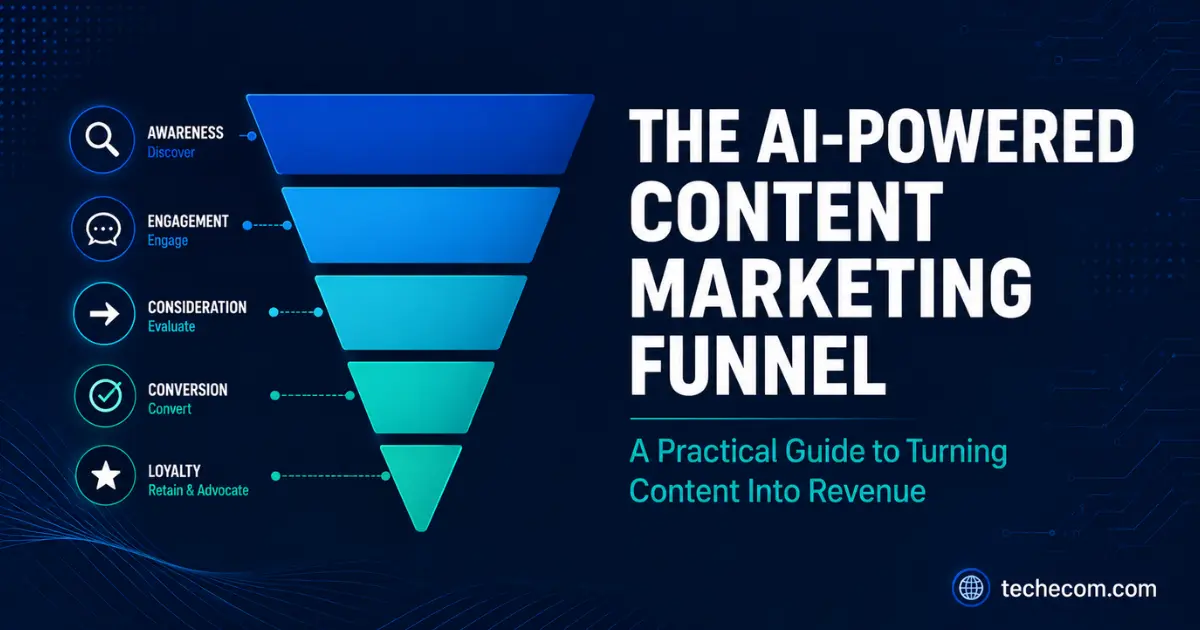
Awareness → Consideration → Intent → Conversion → Loyalty
Each stage has a different job, a different home (search, AI assistants, social, email, your product), and a different way of measuring whether it’s working. Let’s go stage by stage.
Stage 1: Awareness
Goal
Get discovered by people who don’t know your brand yet — and get cited by AI systems answering their questions.
Where It Happens
Organic search, AI Overviews, YouTube, Reddit, Pinterest, and increasingly, direct answers inside ChatGPT or Perplexity. Awareness content also lives on other people’s platforms now — a Reddit comment, a quoted stat in someone else’s newsletter, a screenshot shared on X.
What Works in 2026
Broad, definitional content still earns traffic, but only if it’s structured to be extractable. AI Overviews and chat assistants pull sentences, not vibes. That means:
- Answering the core question in the first two sentences, not after three paragraphs of setup
- Using clear subheadings that match how people actually phrase questions
- Including specific numbers, comparisons, or named examples instead of vague claims
- Building topical depth across a cluster of related pages, not one isolated post
This is also where original data and firsthand testing separate you from the noise. An article that says “AI tools can improve efficiency” is forgettable. One that says “we tested three AI writing tools against the same brief and here’s what changed in output quality” gets remembered, shared, and cited.
Practical Example
A SaaS company selling project management software doesn’t write “What Is Project Management?” — that’s been written 40,000 times. Instead, they publish “Why Most Project Management Rollouts Fail in the First 90 Days,” built from patterns they’ve actually seen across client onboarding. It answers a real question, it’s specific, and it’s the kind of thing an AI assistant is likely to summarize when someone asks “why do PM tool rollouts fail.”
Key Metrics
- Organic impressions and click-through rate
- Citations or mentions in AI-generated answers (trackable via tools like Ahrefs’ Brand Radar or manual prompt testing)
- New-visitor share of traffic
- Branded search volume growth over time (a lagging but honest signal that awareness content is working)
Stage 2: Consideration
Goal
Move someone from “I have this problem” to “I understand my options for solving it.”
Where It Happens
Deeper blog content, comparison pages, YouTube walkthroughs, email nurture sequences, and community spaces like niche Slack groups or subreddits where people ask for recommendations.
What Works in 2026
This is the stage where AI search has changed behavior the most. People used to open six tabs and compare products manually. Now they ask an AI assistant to compare options for them — which means your comparison content needs to be structured so an AI can accurately represent your position, even when a competitor is doing the asking.
What actually moves people forward here:
- Honest comparison content that acknowledges tradeoffs (a comparison page that only flatters your own product reads as untrustworthy, and AI systems trained to detect bias tend to deprioritize it)
- Case studies with specific outcomes, not “results may vary” language
- Interactive tools — calculators, quizzes, cost estimators — that give a personalized answer instead of a generic list
- Content that answers the unspoken objection, not just the stated question
Practical Example
An email marketing platform publishes “Klaviyo vs. Mailchimp vs. [Their Own Product]: What Actually Changes When You Switch,” written by someone who migrated a real account and documented what broke, what improved, and what took longer than expected. It’s more useful — and more linkable — than a features table.
Key Metrics
- Time on page and scroll depth on comparison and case study content
- Return visits within a 7–14 day window (a strong signal of active research)
- Email open and click rates on nurture sequences
- Assisted conversions attributed to consideration-stage content in analytics
Stage 3: Intent
Goal
Capture the moment someone has decided to solve the problem and is now evaluating who to solve it with.
Where It Happens
Pricing pages, product demo requests, free trial signups, sales calls, retargeting ads, and — increasingly — direct questions to AI assistants like “is [product] worth it” or “[product] pricing.”
What Works in 2026
Intent-stage content used to be simple: a pricing page and a demo form. That’s no longer enough, because a meaningful chunk of intent-stage research now happens inside an AI chat window before someone ever visits your site. If ChatGPT is asked “is this tool worth the price,” and the only public information about your pricing is vague or outdated, you lose that moment entirely — the user never even reaches your page.
What works now:
- Transparent pricing pages (even “starts at $X” beats “contact us” for AI-search visibility and user trust)
- FAQ sections that directly address hesitations: refund policy, contract length, switching costs, implementation time
- Social proof that’s specific — real names, real numbers, real before/after — not generic testimonial quotes
- Fast, low-friction conversion paths: shorter forms, clearer next steps, less waiting for a sales callback
Practical Example
A B2B tool replaces its “Request a Demo” form (name, email, company, phone, job title, company size, budget — seven fields) with a three-field form and an option to watch a 90-second product walkthrough immediately, no gate required. Intent-stage friction is often the single biggest funnel leak, and it’s usually self-inflicted.
Key Metrics
- Pricing page to demo/trial conversion rate
- Form abandonment rate
- Sales-qualified lead (SQL) rate from organic and AI-referred traffic
- Time from first visit to conversion (shrinking this is usually a sign the funnel is working)
Stage 4: Conversion
Goal
Turn evaluation into a paying customer, subscriber, or committed action.
Where It Happens
Checkout pages, signup flows, onboarding sequences, sales close calls.
What Works in 2026
Conversion content isn’t really “content” in the traditional sense — it’s experience design supported by the right words at the right moment. The funnel breaks here more often from friction than from persuasion.
- Onboarding content (welcome emails, setup guides, first-use walkthroughs) that gets someone to a “first win” fast, since early product value is the strongest anti-churn signal
- Clear, honest pricing pages with no surprise fees revealed at checkout
- Removing unnecessary steps between “I want this” and “I have this”
- Post-purchase confirmation content that reduces buyer’s remorse — a short “here’s what happens next” message does more for retention than people expect
Practical Example
A subscription box service found that customers who completed a simple onboarding quiz (three questions, 30 seconds) had a 22% lower first-month cancellation rate than those who skipped it. The quiz wasn’t sales content — it was a conversion tool disguised as personalization, and it worked because it got the customer to feel understood before their first shipment even arrived.
Key Metrics
- Checkout or signup completion rate
- Cart or form abandonment rate
- Time to first value (how long until a new customer/user does the thing that proves the product works)
- 30-day churn or refund rate
Stage 5: Loyalty
Goal
Turn a one-time customer into a repeat buyer, referrer, or advocate — and turn your existing users into a source of the trust signals AI systems and search engines now reward.
Where It Happens
Email, community, customer education content, review platforms, referral programs, and your own product.
What Works in 2026
Loyalty is the most underinvested stage in most content strategies, and it’s become more valuable, not less. Here’s why: AI search systems and Google both increasingly weigh signals like branded search volume, direct traffic, review sentiment, and user-generated mentions as trust indicators. A brand with a loyal, vocal customer base gets cited more often — by search engines and by AI assistants summarizing “what do people think of X.”
Practical moves that build this:
- Customer education content (advanced tips, use-case deep dives) that keeps existing users engaged, not just new ones
- Review and testimonial requests timed to a customer’s best moment — right after a win, not on a random 90-day email schedule
- Community spaces where customers help each other, which reduces support load and generates organic content you didn’t have to write
- Referral incentives that are simple enough to explain in one sentence
Practical Example
A project management tool runs a quarterly “how our customers actually use this” content series, built entirely from real workflows customers submit. It costs almost nothing to produce, it consistently outperforms company-written content in engagement, and it generates the kind of specific, first-person language that AI summarization tools tend to pull from when answering “how do people use [tool].”
Key Metrics
- Repeat purchase or renewal rate
- Net Promoter Score (NPS) or review volume/sentiment over time
- Referral-driven signups
- Branded search volume trend (a strong long-term proxy for loyalty and word-of-mouth)
How AI Actually Changes the Funnel
Here’s the honest version, without the hype.
AI hasn’t replaced the funnel. It’s changed three specific things about how the funnel operates, and understanding those three things matters more than any tool you could buy.
First, research has compressed. Stages that used to take days — comparing options, reading reviews, checking pricing — can now happen in one conversation with an AI assistant. That means your Awareness and Consideration content needs to work harder in less time, because the window to influence a decision is shorter.
Second, your content now has two audiences: humans and machines. Every piece you publish is potentially being read, summarized, and re-served by an AI system to someone who never visits your site directly. That’s not a reason to write for robots — it’s a reason to write with enough clarity and specificity that a machine summarizing you can’t get it wrong. Vague content gets vague summaries. Specific content gets accurately represented.
Third, production speed stopped being a competitive advantage. When everyone can generate content quickly, the advantage shifts entirely to what AI can’t generate on its own: real experience, tested claims, original data, and a point of view. This is genuinely good news if you’ve been in your industry a while — your unfair advantage isn’t writing faster, it’s knowing things a language model has never actually done.
What hasn’t changed: people still buy from brands they trust, funnels still leak at points of friction, and content that doesn’t answer a real question still doesn’t work — AI or no AI.
Implementation Plan: How to Actually Build This
A framework is only useful if you can act on it this week. Here’s the sequence.
Step 1:
Map your current content against the five stages. Pull your existing content into a spreadsheet and tag each piece: Awareness, Consideration, Intent, Conversion, or Loyalty. Most sites discover they have a mountain of Awareness content and almost nothing for Intent or Loyalty. That imbalance is usually the actual reason traffic isn’t converting.
Step 2:
Identify your biggest single leak. Look at your analytics funnel, not your traffic numbers. Where’s the biggest percentage drop — top of funnel to consideration, or intent to conversion? Fix the biggest leak before creating more top-of-funnel content. More traffic into a broken funnel just means more people leaving.
Step 3:
Build one strong asset per stage before adding more volume. Rather than publishing ten new blog posts, pick one high-quality piece for whichever stage is weakest: one honest comparison page, one specific case study, one simplified conversion form. Depth beats volume at this point in the funnel more than almost anywhere else.
Step 4:
Structure content for AI extractability. For every important page, ask: if an AI assistant summarized this in two sentences, would it get the point right? If not, restructure with a direct answer near the top, clear subheadings, and specific claims instead of vague ones.
Step 5:
Set up tracking that actually reflects the new funnel. Standard analytics won’t show you AI citation traffic or assisted conversions well. Add UTM tracking to anything AI-referenced, monitor branded search volume monthly, and periodically test your own brand’s visibility inside ChatGPT and Perplexity by asking the questions your customers would ask.
Step 6:
Revisit the funnel quarterly, not annually. Because research behavior is shifting quickly, a funnel audit that made sense six months ago may already be missing a stage or overweighting a channel that’s declining. Quarterly is frequent enough to catch drift without turning strategy into a full-time obsession.
Common Mistakes That Quietly Kill the Funnel
- Treating traffic as the goal instead of the metric. Ranking for a keyword that brings in the wrong audience is worse than ranking for nothing. High traffic with no conversions isn’t a top-of-funnel win — it’s a sign the content is attracting the wrong intent entirely.
- Skipping the Intent stage because “the sales team handles that.” Sales can’t close a lead who never got their objection answered in the research phase and quietly left. If your public content doesn’t address pricing, contract terms, and common hesitations, you’re losing people before sales ever gets a chance.
- Writing comparison content that’s obviously biased. Readers can tell when a “vs.” article only flatters one side, and increasingly, so can AI summarization systems trained to detect one-sided framing. Biased comparison content gets cited less, not more.
- Ignoring existing customers in the content strategy. Most content budgets go almost entirely to acquisition. But loyalty-stage content is often cheaper to produce (you’re documenting real customer behavior, not inventing new topics) and it directly feeds the trust signals that both search engines and AI systems now weigh heavily.
- Confusing “AI-optimized” with “written by AI.” These are opposite strategies. Content optimized for AI search still needs to be built on real experience and specific detail — the things AI-generated content is worst at producing. Publishing generic AI-written content to “rank in AI search” is treating the symptom, not the cause.
Conclusion
The funnel isn’t dead, and it isn’t magic. It’s still the same basic idea it’s always been: meet people where they are, answer what they actually need at that moment, and remove whatever’s stopping them from moving forward.
What’s changed in 2026 is the terrain. Research happens faster. AI systems sit between you and a growing share of your audience. And generic content — the kind that used to be “good enough” — now has almost no competitive value at all.
The brands that win this version of the funnel aren’t the ones publishing the most. They’re the ones who mapped their content honestly against real stages, fixed their biggest leaks first, and built a handful of genuinely useful assets instead of a hundred forgettable ones.
Start with the audit. Find your leak. Fix one stage properly before moving to the next. That’s the whole playbook — it just takes discipline to actually run it.
Want more practical, no-fluff guides on AI content strategy, SEO, and digital growth? Visit: techecom.com